
Two years ago I had my left knee replaced, and for the first few months I thought the hardest part was the surgery itself. It wasn't. The hardest part was learning which walking aid to trust on which day. My physical therapist had me start with a standard walker, then a rollator for outings, and somewhere in that first year I realized I still needed something lighter for the short stuff: the walk from the car to the grocery store, the hallway to the bathroom at 2 a.m., and the three steps up to my front porch. That's when Kathleen, my daughter, handed me a BeneCane offset-handle cane and said, "Try this one before you buy anything else." I've used it nearly every day since, and this is the review I wish someone had written for me back then.
The Quick Verdict
The BeneCane is the rare mobility aid that disappears into your day. It's light, it folds small, and the offset handle keeps my wrist straight while the cane carries weight. It won't replace a walker or rollator, and it shouldn't, but for short errands, uneven sidewalks, and poker night it's been my steady companion for about a year.
Amazon Check Today's Price →The cane I reach for on short days
If you're past the walker stage but not ready to trust an unsteady hand on a plain straight cane, the BeneCane offset cane is the middle step that worked for me. It's adjustable, folds to fit beside a chair, and weighs about as much as a small bag of coffee.
Amazon Check Today's Price on Amazon →How I've Used It
I bought my BeneCane about a year ago, roughly a year after the knee replacement, once my physical therapist said I was steady enough to move between the rollator and something lighter. The rollator is still my outing aid for the grocery store and Mahjong Tuesdays at the senior center, because I like having a seat when I wait. But the BeneCane is what I grab for the shorter, easier days. It's my around-the-house aid, my short-errand aid, and my Friday night poker aid, where it folds to 17 inches and tucks right beside my chair.
My physical therapist set the height for me, and I've kept it there. That matters more than people think. With an offset cane the handle is meant to sit so your wrist stays straight and your elbow bends just a little, and when the height is right the cane does the work instead of your hand doing a death grip. I also use it on the two steps up to my front porch, and on the uneven ground around the park where I play gentle pickleball doubles on Saturday mornings. It is not my hiking pole and it is not my rollator. It is the in-between aid, and for that job it has been excellent.
I should say the obvious thing: a cane is not a medical treatment, and I am not a doctor. What I can tell you is how it feels to live with one. The BeneCane gives me back the confidence to walk to the mailbox without planning a route around every crack in the sidewalk, and that confidence took weeks to build, not one afternoon. If you are newly past surgery, give yourself that time. Ask your doctor or physical therapist about fit and use, set the height where they say, and let the cane become boring. That is exactly what it should be.
What Makes the Offset Handle Different
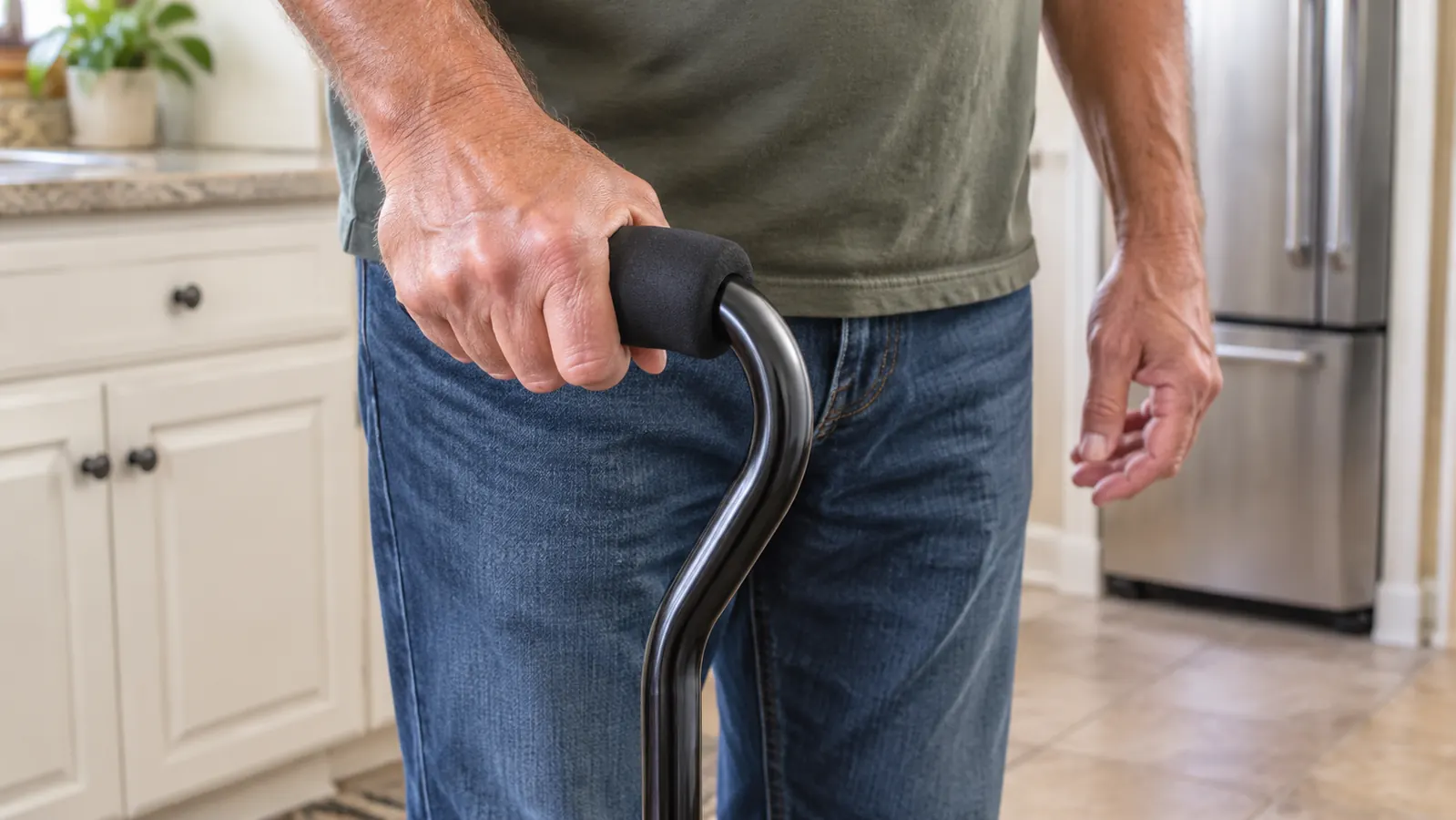
The whole point of an offset cane is the handle. On a plain straight cane, your wrist bends back at an awkward angle and your weight lands on the soft spot between your thumb and fingers. With the BeneCane's offset handle, the shaft of the cane angles forward so the force runs straight down through your arm and into the ground. For me, with mild arthritis in both hands, that straight line is the difference between a comfortable walk to the corner and a sore hand by the time I get home.
The handle itself is foam, and after a year of daily use it still has plenty of cushion. I was skeptical at first because foam sounded like it would squish flat, but it hasn't. It also stays put in my hand, which matters more than I expected. My hands sweat a little when I'm nervous, and the foam grips better than the bare metal or hard plastic handles I tried on other canes. The rubber base tip is sturdy and has held up well on concrete, tile, and the asphalt path around the park. I replaced the tip once after a year, mostly because I wanted a fresh one before winter, not because it had worn through.
The cane is aluminum and weighs 12.8 ounces, which is light enough that I sometimes forget it's hanging on my arm while I dig for my keys. The push-button lock lets me adjust the height from 31 to 36 inches in seconds, though I set mine once and haven't touched it since. The whole thing folds to 17 inches, which is the feature I didn't know I needed until I tried to fit a rigid cane into a small sedan trunk. Mine lives in the car when I'm out, and it rides beside my chair at poker night. Kathleen has also borrowed it twice when she had a sore knee after a long hike, and she adjusted the height for herself in about ten seconds.
A Year of Real Use: What Held Up
After a year of near-daily use, I can tell you what has held up and what hasn't. The aluminum shaft looks almost new. The foam handle has softened slightly with use, but it hasn't flattened or torn, and it still gives me the cushion I need. The push-button lock has never slipped, which was my biggest worry when I bought it. I am not a small person, and I lean on this cane more than I probably should, and it has never once folded up underneath me. That is the thing I care about most, and it has been rock solid.
The rubber tip is the one part I'd call a wear item. After a year of daily use on concrete and asphalt, the tread had worn down enough that I ordered a replacement tip. That's normal for any cane, and it cost me a few dollars. The folding joint in the middle still clicks open and closed smoothly, and the screw-coupled joint that locks the height in place has never loosened on its own. I check it every few weeks out of habit, and it has always been snug.
The one thing I'd change is the included instructions, which are minimal. The cane itself is simple enough that I didn't need much, but if you've never used an offset cane before, the right height and hand position are not obvious. My physical therapist showed me in two minutes, and I'd tell anyone buying this to do the same. Ask your doctor or physical therapist to check your fit. It's the single best thing you can do with any cane, and it's free.
The cane has never once folded up underneath me, and that is the thing I care about most. After a year of leaning on it daily, it has been rock solid.
Where It Shines and Where It Doesn't
The BeneCane shines on flat, predictable ground: my hallway, the grocery store aisle, the sidewalk to the senior center, the floor of the card room at the community center. It shines on short trips where a rollator feels like too much machinery. It shines when I need something that folds small enough to tuck beside a chair or into the trunk of my small sedan. It shines in the middle of the night, when I need one steady point of contact between the bed and the bathroom and I don't want to wrestle with a walker.
It does not shine on steep hills, loose gravel, or anything that requires serious weight-bearing. For those, I use the rollator, which has four points of contact and a seat if I need to stop. The cane is also not a substitute for the toilet safety rail I installed after surgery, or the bed assist rail Kathleen set up for me. Each aid does its own job. The cane's job is to give me one steady point of contact on easy days, and it does that job beautifully.
One more honest note: the cane is rated for 300 lbs of use, which is reassuring, but I am not the person to test the top end of that rating and I don't intend to become the person who does. If you are a larger person, check the rating and talk to your doctor or physical therapist about whether a cane is the right aid for you. A single point of contact is not right for everyone.

How It Compares to What I Tried Before
Before the BeneCane, I tried a plain straight cane from the drugstore, and I hated it. My wrist ached, the handle dug into my palm, and I stopped using it within a week. That experience is exactly why I was skeptical when Kathleen handed me the BeneCane. The offset handle looked like a small difference, but it is not a small difference. It changes where the weight goes, and that changes whether my hand hurts at the end of the day.
I also considered a quad cane, which has four small feet at the base and stands up on its own. I tested one at the drugstore and decided against it. The four feet made it heavier and clumsier to move with each step, and it did not fold. For my needs, the folding feature of the BeneCane won. If you want the full comparison, I wrote up my notes on the BeneCane versus a quad cane separately, including who should pick which.
The other thing I compared was the folding mechanism. Some folding canes have a bungee cord that runs through the middle, and they fold by pulling the sections apart. The BeneCane uses a push-button lock and a screw-coupled joint in the middle, and I find it more secure. There is no cord to stretch or snap, and no risk of the sections separating when I don't want them to. The push-button lock is simple and it has never failed me.
What I Liked
- Offset handle keeps my wrist straight and comfortable, even with mild arthritis in my hands
- Weighs 12.8 ounces, light enough to carry on my arm without thinking about it
- Folds to 17 inches, small enough for the trunk of my sedan or beside a chair at poker night
- Push-button height adjustment from 31 to 36 inches, easy for my daughter to set in seconds
- Aluminum shaft and foam handle have held up well through a year of daily use
- Rubber tip has good durability and is easy to replace
Where It Falls Short
- Not for steep hills, loose gravel, or anyone who needs more than one point of contact
- Instructions are minimal; you really should have a physical therapist check your fit
- The rubber tip is a wear item and will eventually need replacing
- Folding joint means one more moving part, though mine has never slipped
Who This Is For
The BeneCane is for you if you are past the walker stage but not ready to trust a plain straight cane. It is for you if you have wrist or hand discomfort and want a handle that keeps your hand in a natural position. It is for you if you need something that folds small enough to fit in a car trunk, under a chair, or beside a bed. It is for you if you want one aid for short, easy days and a rollator for the long ones.
It is also for you if you are the family member of someone who needs a little steadiness. Kathleen bought mine for me, and I have bought one for a friend at the senior center who was struggling with a wobbly drugstore cane. It is a practical, no-regrets gift that says "I want you to stay steady and keep doing the things you love." My friend now brings hers to Mahjong on Tuesdays, and we compare notes on which sidewalks are smoothest.
Who Should Skip It
Skip the BeneCane if you need more than one point of contact. If your balance is unsteady even on flat ground, if you need a seat when you walk, or if your doctor or physical therapist has told you to use a walker or rollator, a cane is not the right tool. I use my rollator for the grocery store and the park, and I would not trade it for a cane on those outings. The cane is for the days when one steady point of contact is enough.
Skip it if you are a larger person near the top of the 300 lb rating and you are not sure a single-point cane is right for your weight and balance. Talk to your doctor or physical therapist. And skip it if you expect a cane to fix pain or replace rehabilitation. It won't. It is a tool that helps you move with more confidence while you do the real work of strengthening and healing. That real work is what got me back to pickleball, Mahjong, and poker night. The BeneCane just made the walk there steadier.
A year in, I still reach for it daily
If you or someone you love is between the walker and the world, the BeneCane offset cane is the steady middle step. It folds small, weighs almost nothing, and the handle is kind to your wrist. Check today's price on Amazon and see if it's the right fit for your short, easy days.
Amazon Check Today's Price on Amazon →