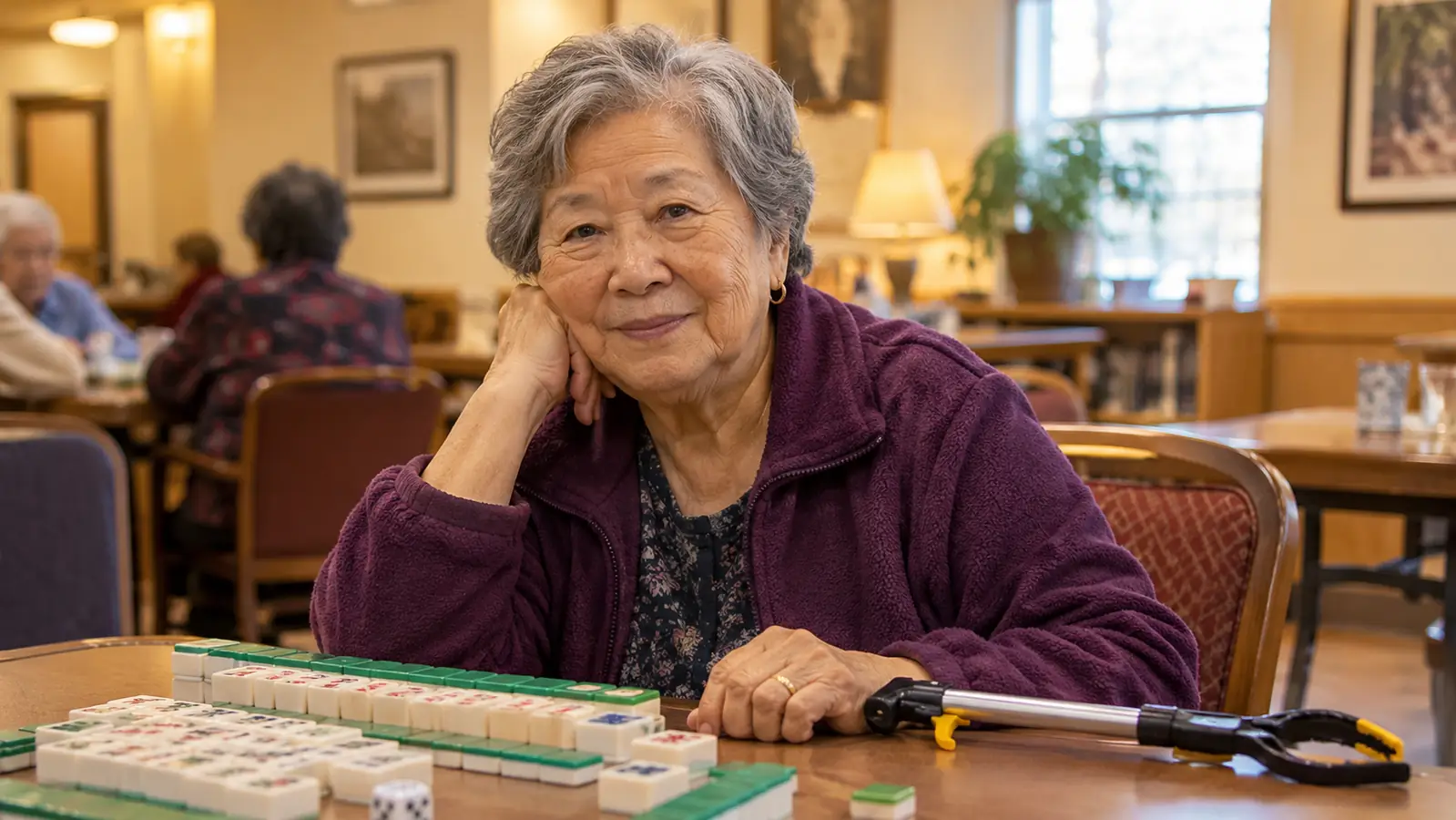
The tile hits the floor and the whole table goes quiet for half a second. Then somebody says, "I'll get it," and you watch someone half my age bend down like it costs them nothing. I used to be the one who bent down. Two years after my knee replacement, I am the one doing the math about whether it is worth the twist. That is exactly why I bought the ZAYAD foldable reacher grabber, and it is why I keep one by the couch for Mahjong Tuesdays.
This is not a guide about the fanciest grabber on the market. It is about the small, ordinary moment that happens every single game: a tile drops, and you need to get it back on the table without turning your whole body into a question mark. Here is how I do it now, step by step, with the same ZAYAD grabber I have used for about a year and a half.
Keep a Reacher Where You Actually Play
The ZAYAD foldable 32 inch reacher grabber folds down to about 17.7 inches, so it can live beside the couch instead of in a drawer. Check today's price on Amazon and see the current listing.
Amazon Check Today's Price on Amazon →Step 1: Keep the Reacher Where the Tiles Are
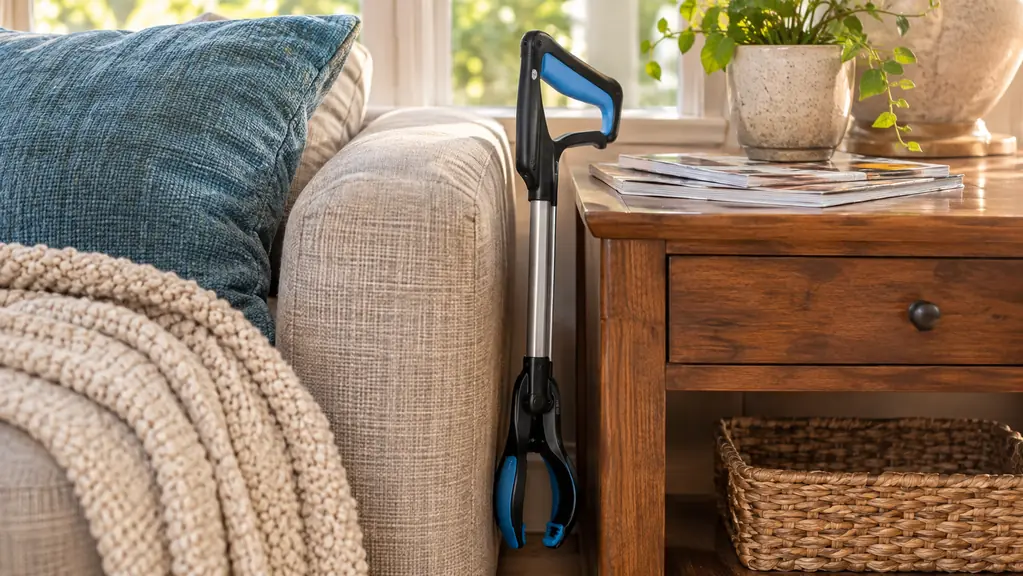
The first step is not technique. It is location. A reacher only helps if it is within arm's reach when the tile drops, because the whole point is that you do not have to get up and walk across the room to fetch a tool. I keep one ZAYAD grabber tucked between the couch cushion and the end table where I sit for Mahjong. It folds down to about 17.7 inches long and weighs about 8.6 ounces, so it does not look like medical equipment sitting there. It just looks like a thing I keep by my chair.
The folded size matters more than I expected. The listing gives the folded dimensions as 17.7 by 5 by 1.6 inches, and that rectangle slips into the door pocket of my small sedan without sticking out. I measured it against the owner's manual pocket just to be sure, and it cleared by a good inch. My small sedan has an ordinary trunk, and the ZAYAD folds small enough that I can also keep one in the car for errands. But for the card table, the habit is the whole trick: when I sit down, the reacher goes on the table edge or on the floor beside my chair. When a tile drops, I do not have to think about where the tool is. It is already where I am.
One note from experience: pick a spot and keep it consistent. The Tuesday Mahjong table at the senior center is not my couch, so I bring the folded reacher in my bag and set it on the floor next to my chair before the first hand. That thirty-second habit saves me from ever having to ask someone to hand me the grabber, which is somehow more embarrassing than dropping the tile in the first place.
Step 2: Get Low Without Bending at the Waist
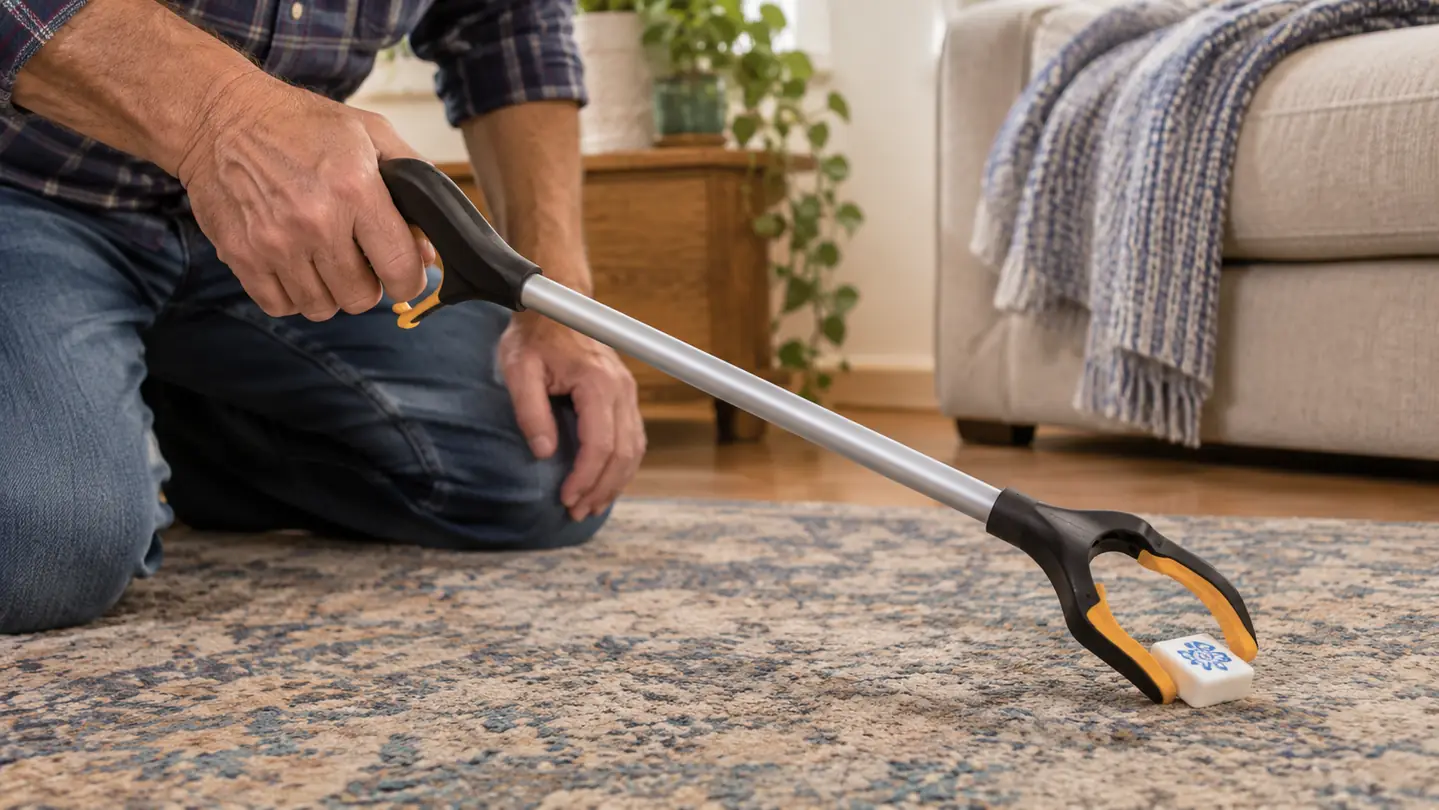
Here is the part that took me a while to learn, and I learned it the hard way on a Tuesday in March. A tile dropped during the second hand, I bent at the waist out of pure habit, and my knee ached for the rest of the afternoon. Nobody said a word, but I heard my physical therapist in my head, telling me not to twist. The reacher does not do the bending for you. It extends your arm, but you still have to get your hand down near the floor. The trick is to let your legs do the lowering instead of your back. I brace one hand on the table or the arm of the chair, step the foot on my good side forward, and lower myself into a slight crouch. Then I extend the ZAYAD grabber toward the tile. The 32 inch reach means I can get the claw to the floor without crouching as deep as I would if I were reaching bare-handed.
My physical therapist gave me a version of this advice when I first came home from the hospital, and it applies just as well to picking up a Mahjong tile as it does to picking up the mail. Do not twist. Turn your whole body to face the tile, keep your feet planted, and let the reacher do the reaching. If you are not sure about your own balance or your knee, ask your doctor or physical therapist about the right way to lower yourself. What works for me is a small forward step and a shallow bend, never a deep fold at the waist.
If the tile is under the table, I do not try to reach it from my chair. I push my chair back, get up, and approach it from the side where I can see the claw. Seeing what you are grabbing is half the job. The ZAYAD's claw opens wide enough to take a tile flat, and the trigger handle closes it with a simple squeeze. But you still need to be able to see the tile and the claw together, or you will push the tile across the floor like a hockey puck.
Step 3: Line Up the Claw, Then Squeeze
The actual pickup is the easiest part, once you line it up. I position the claw so the tile sits in the center of the opening, with the claw's jaws on either side of the tile rather than on top of it. Then I squeeze the handle gently and lift. The ZAYAD is designed for easy grabbing: you pull the handle and the jaws close around coins, envelopes, trash, or in my case, a little white Mahjong tile. A slow squeeze gives you more control than a fast one, because the tile does not shoot out sideways.
Grip the handle with your whole hand, not just your fingers. I have mild arthritis in both hands, and I have learned that a full-palm grip on the trigger handle spreads the effort across my hand instead of loading one finger joint. The first few times I used the reacher, I grabbed it the way I grab a TV remote, with my fingertips, and my index finger ached by the third pickup. Once I switched to wrapping my whole hand around the handle and squeezing with my palm, the ache went away. The ZAYAD weighs about 8.6 ounces, so the tool itself is not heavy. The work is in the control, and the control comes from keeping your wrist straight and letting the handle do the closing.
If the tile is lying face down, I do not try to flip it with the claw. I pick it up the way it lies and turn my wrist once it is in the air. Flipping a tile on the floor usually just slides it farther under the table. I figured this out the day I spent a full minute pushing a face-down tile in circles before I finally picked it up the way it lay. The claw is for grabbing, not for flipping. Pick it up first, then rotate your wrist. That one habit saves a lot of crawling around on hands and knees.
Step 4: Bring the Tile Up to Table Height, Not Down to Your Hand
Once the tile is in the claw, the natural instinct is to lower your hand, take the tile, and put it on the table. I have learned to do the opposite. I bring the reacher up to table height and drop the tile onto the table or into my other hand. That way I am not bending again, and I am not transferring the tile at floor level where I might drop it a second time.
This is the move that makes me look almost graceful at the card table. The whole sequence is: lower into a small crouch, reach, squeeze, lift to table height, release. It takes about five seconds once you have done it a few times. The first time I used the ZAYAD at Mahjong, everyone stopped to watch. The woman next to me asked if she could try it, and she spent the next ten minutes picking up everything she could reach, including a napkin she did not need and a stray poker chip from the table behind us. Now nobody even looks up, which is exactly what I wanted.
Release the tile by relaxing your grip on the handle, not by shaking the reacher. A steady release sets the tile down right where you want it. If you are putting the tile into your hand, position your palm under the claw before you release, so the tile falls a half inch instead of a foot.
Step 5: Fold It and Put It Back in Its Spot
The last step is the one most people skip, and it is the one that keeps the reacher useful. The ZAYAD folds down to about 17.7 inches, so it takes two seconds to fold and tuck back beside the couch cushion or into my bag. I learned this the week I left it out and nearly stepped on it in the dark on my way to the kitchen. Nothing happened, but it was a loud reminder. If I leave it lying on the floor, it becomes a trip hazard, which is the last thing I need with my balance being what it is. Fold it, put it back, and it is ready for the next dropped tile.
The foldable design is also why I can keep one in the car. It stores in the door pocket or under the seat, and it is there when I need to pick up something in a parking lot without bending over the new knee. The ZAYAD listing says it folds for easy storage in closets, drawers, or vehicles, and I can confirm that from real life. Mine has lived in all three places.
Cleaning is simple: a damp cloth over the claw and handle when the grip gets dusty, and let it air dry. I have never had to do anything else to mine in about a year and a half of weekly use. It just works.
What Else Helps
The ZAYAD reacher is my tile-and-chip tool, but it is not the only thing that keeps me at the table. When I walk to the senior center, I use my Drive Medical rollator with the seat, because the walk is longer than my balance likes. On short evenings, like Friday poker at the neighbor's house, I bring the BeneCane offset-handle cane and fold it small beside my chair. The reacher handles the floor, the cane handles the walking, and the rollator handles the distance. They are different tools for different jobs, and I do not ask any one of them to do another one's work.
If you are considering a reacher for the first time, the practical question is not which brand is best. It is where you will actually keep it. A reacher that lives in a drawer is a reacher you will not use. Put it where the drops happen, and you will wonder how you ever played without it. And as always, if you have questions about bending, balance, or your own recovery, ask your doctor or physical therapist. They know your body better than any tool does.
A reacher that lives in a drawer is a reacher you will not use. Mine lives beside the couch, and it has saved my knee a thousand small bends.
Make the Next Dropped Tile a Non-Event
The ZAYAD foldable 32 inch reacher grabber folds to about 17.7 inches, weighs about 8.6 ounces, and is the thing I reach for first when a tile hits the floor. See today's price on Amazon and decide if it belongs beside your chair too.
Amazon Check Today's Price on Amazon →