

Somewhere in my garage there is a cane I bought before I knew better. It is the kind with the curved top that digs into your palm on every step, and I lasted about two weeks with it before I gave up. In the back of my coat closet is the one that was somehow too short no matter how I adjusted it. If you are shopping for a cane because your balance has gotten less reliable, or because a knee replacement taught you that a curb is a negotiation, you probably have the same worry I had: how do I know this one will actually feel right? I bought the BeneCane offset cane about a year ago, after my physical therapist set the height and told me to stop guessing. A year later it is the aid I reach for on short-errand days, and I have opinions. This is the honest version of that story, including the parts that annoy me.
The Quick Verdict
Light enough to forget you are carrying it, folds small enough to tuck beside a chair at poker night, and the offset foam handle is genuinely kind to arthritic hands. The push-button height adjustment takes a little patience, and the foam handle shows daily use. I would buy it again.
Amazon Check Today's Price →The cane I reach for on short-errand days
The BeneCane folds to 17 inches, weighs 12.8 ounces, and adjusts from 31 to 36 inches with a push button. If that matches what you need for short outings, today's price is worth checking.
Amazon Check Today's Price on Amazon →How I've Used It for a Year
I bought the BeneCane about a year ago, not right after my knee replacement. In those first months I used a standard walker, then the rollator I still keep for outings. The cane came later, once my physical therapist said I was ready for something lighter on shorter days. She set the height for me, and that is the first thing nobody tells you: the height is the whole review. A cane set too high or too low will make your shoulder ache and your balance worse, and no amount of handle padding fixes that. The BeneCane adjusts from 31 to 36 inches with a push button, and once you find your number, you tighten a screw-coupled joint in the middle so it stays put. I have not touched that button since the day she set it.
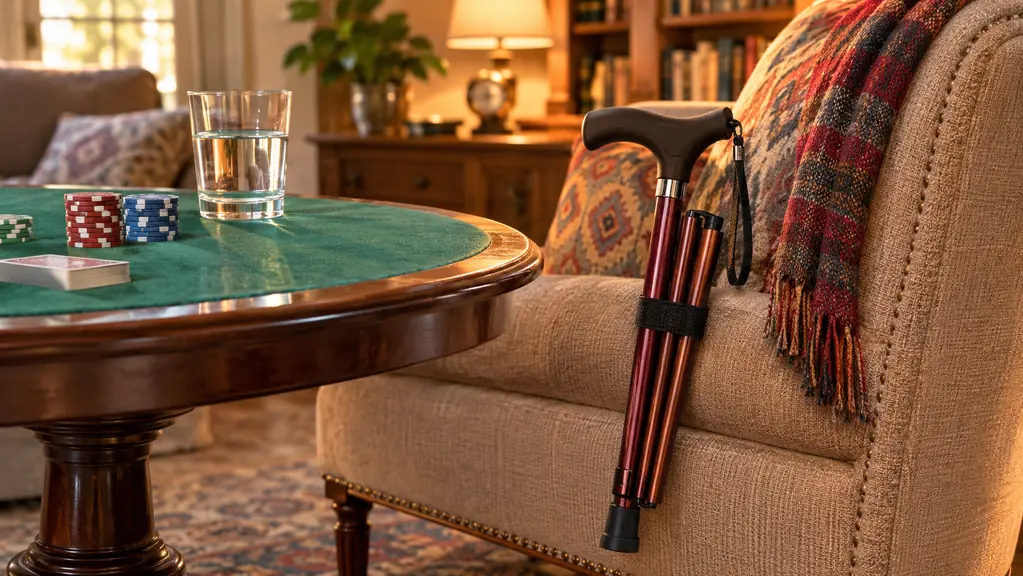
My week is the reason the cane matters to me. Mahjong on Tuesdays at the senior center, poker with the neighbors on Friday nights, and gentle pickleball doubles on Saturday mornings at the park. The rollator comes along for the long outings. The BeneCane is what I grab for the short errands: the pharmacy, the post office, the walk from the car to Kathleen's front door. It folds to 17 inches, which means it tucks beside my chair at poker night instead of leaning against the wall where someone will trip over it. At 12.8 ounces, I honestly forget I am carrying it. That sounds like a small thing until you have carried a cane through a full day and felt the difference in your shoulder.
The first thing I noticed was the handle. The offset design puts my wrist in a more natural line than the curved-top cane ever did, and the foam cushion spreads the pressure across my palm. I have mild arthritis in both hands, and this is the first cane I have used where my grip does not ache by the end of the evening. That alone would have been worth the switch. The handle is foam, not the hard plastic or wood you find on cheaper canes, and the listing says the cane is made with a larger diameter tube. What that means in practice is that it feels steadier than its 12.8 ounces would suggest.

What Nobody Tells You About a Cane
Here is the honest part. A cane is not a smaller walker. It is a different tool for a different job, and most of the people I know who hate their canes are people who needed more support than a single point can give. On uneven ground, when I am tired, or on the two steps up to my front porch, I still want the rollator or a hand on the rail. The cane is for steady ground and short distances, and the sooner you accept that, the happier you will be with it. Nobody tells you that part in the product listing. The listing tells you the cane is rated for 300 lbs and adjusts from 31 to 36 inches. It does not tell you when you should leave it at home.
The push-button adjustment is the thing that annoys me most, and I want to be specific about it. It works exactly as described: press the button, slide the inner tube, release. But it takes two hands and a little fiddling, and the first few times I did it, the button caught on the hole and I had to wiggle it free. Once the screw-coupled joint is tightened, it stays put, so this is a setup annoyance, not a daily one. If you have limited grip strength or only one good hand, you will want someone else to set the height for you. My physical therapist did mine, and I have not needed to touch it since. I would not call it a dealbreaker. I would call it the thing you should know before you buy.
The second thing nobody tells you: the foam handle shows daily use. It is comfortable, genuinely, but it picks up whatever is on my hands, and after a year it looks lived-in. A damp cloth fixes it in about thirty seconds, and I do that every couple of weeks. I mention it because the product photos make the handle look brand new forever, and it is not. That is not a reason to skip the cane. It is a reason to know what you are buying, and I would rather read that in a review than discover it after my first week.
The third thing: because the cane is so light, I have left it behind twice. Once at the post office, where I set it on the counter to sign for a package, and once at Kathleen's house, where it stayed propped against her kitchen island for a week. The rollator is too heavy to forget. The cane is easy to forget, and that is a tradeoff, not a flaw. I now hang it on my arm before I sign anything, and I keep a reacher grabber in the car for the days I need to pick something up without bending. Every aid has its habits. These are the cane's.
How It Holds Up After a Year
I have used this cane almost daily for about a year, and the honest report is good. The aluminum frame has no dents and no wobble. The rubber tip is still on the cane and still has tread, which matches what the listing says about durability, and I check it every few weeks because a worn tip is the one thing that will actually make a cane unsafe. The push button still clicks cleanly. The screw-coupled joint in the middle has not loosened on its own. I expected to be replacing the tip by now, and I am not.
The listing says the cane is rated for 300 lbs and made with a larger diameter tube, and that is the part I was most skeptical about, because the cane is so light. What that feels like in practice is steadier, with less of the hollow sway you get from a flimsy tube. The aluminum is thin enough to keep the weight at 12.8 ounces and stiff enough to feel solid under load. That combination is the whole trick of a good cane, and BeneCane gets it right. I have leaned on this cane hard when I was tired, and it has never buckled or bent.
BeneCane includes a one-year warranty and a single instruction sheet in the box. I have not needed the warranty. I have needed the instruction sheet exactly once, when I folded the cane for the first time and could not figure out which end to pull. It is not complicated. It just is not obvious, and I say that as someone who has owned a walker, a rollator, a toilet safety rail, and a bed assist rail over the past two years. This cane is the simplest piece of gear I own, and it still took me one read of the instructions to fold it right.
The offset handle looks like a small design detail. It is not. It is the difference between a cane I reach for and a cane that would have ended up in the garage with the others.
Alternatives I Considered
I did not buy this cane blind. I tried the curved-top cane that lives in my garage now, and I borrowed a quad cane from a neighbor before I settled on the offset style. The quad cane has four points on the base, which means it stands up on its own and feels more planted on uneven ground. It is also heavier and wider, and it does not fold as small. For me, on short errands and at a card table, the folding size won. If you are weighing a single cane against a quad cane, the comparison on this site walks through it row by row, including the places where the quad cane genuinely wins.
The rollator is the other thing people ask me about, and it is not really an alternative to the cane at all. They do different jobs. The rollator has a seat, which I use at the senior center while I wait for the Mahjong table to open, and bigger wheels, which handle the walk to the park. The cane is for the short, steady stuff. If you can only buy one, buy the one that matches your hardest regular task, not your easiest. For me, that meant buying both, at different times, and I use both every week. The cane did not replace the rollator. It replaced the times I was reaching for the rollator when I did not need it.
What I'd Tell a Friend Shopping for a Cane
If we were sitting at my kitchen table and you told me you were shopping for a cane, here is what I would say. First, talk to your doctor or physical therapist before you buy anything, and bring the cane to your next appointment so they can set the height for you. The height is not a suggestion. It is the difference between a cane that helps and a cane that hurts. Second, buy the lightest cane that still feels steady, because you will carry it more than you think. Twelve point eight ounces sounds like nothing until you have carried a heavy cane through a parking lot.
Third, decide where the cane will live before you buy it. Mine lives by the front door for short errands and folds to 17 inches for poker night. If yours needs to live in a car, check the folded size. If it needs to live in a bedroom, check the weight. The best cane is the one you will actually use, and you will use the one that fits the spot where you need it. Fourth, check the rubber tip now and then and replace it when it wears. BeneCane's tip has lasted me a year, but every tip wears eventually, and a bare tip on a hard floor is how people fall.
What I Liked
- Weighs 12.8 ounces, easy to carry through a full day of short errands
- Folds to 17 inches, tucks beside a chair or into a small car trunk
- Offset foam handle spreads pressure, genuinely kind to arthritic hands
- Push-button height adjustment from 31 to 36 inches, with a screw-coupled joint that keeps it locked
- Rated for 300 lbs with a larger diameter tube, feels steadier than its weight suggests
- One-year warranty included
Where It Falls Short
- Push-button adjustment takes two hands and a little patience
- Foam handle shows daily use and needs a periodic wipe
- So light it is easy to leave behind
- A single-point cane is not enough support for uneven ground or long outings
Who This Is For
Buy the BeneCane if you need a light, steady hand on short errands and around the house. Buy it if your grip aches with a curved-top cane, because the offset foam handle is the real reason this one works for me. Buy it if you want something that folds to 17 inches and disappears beside a chair or into an ordinary car trunk. Buy it if your doctor or physical therapist has cleared you for a single-point cane and you want one you will actually use. I use mine almost every day, and I would buy it again.
Who Should Skip It
Skip it if you need more support than a single point can give. If your balance is unsteady on uneven ground, if you need to sit down mid-errand, or if you are still early in recovery, a quad cane or a rollator is the safer choice, and no cane is a substitute for what your doctor or physical therapist recommends. Skip it if you cannot manage the push-button adjustment with one hand and do not have someone to set the height for you. And skip it if you expect a cane to fix a medical problem. It will not. It is a tool for steadiness and confidence, and it does that job very well. The people it disappoints are usually the people who needed a different tool. For a longer look at daily use, the long-term review on this site covers the first year in more detail.
The honest bottom line
A year in, the BeneCane is the aid I reach for most on short days. If your doctor or physical therapist has cleared you for a cane, today's price is worth a look.
Amazon Check Today's Price on Amazon →