

I have both sitting in my garage right now. The standard walker, the kind with four legs and no wheels, was what my physical therapist sent me home with after my knee replacement two years ago. It did its job. I leaned on it, I shuffled with it, I kept it by the bed at night. And the moment I was cleared to move on, it went into the corner and never came back out. The Drive Medical rollator with the seat, on the other hand, has been with me for about 20 months, and I take it to the grocery store, to Mahjong on Tuesdays, and on the walk to the park. If you are trying to decide between the two, here is the honest difference: a standard walker is a tool for healing, and a rollator is a tool for living.
I am Bernie, 72 years old, and I live in Watsonville, California, in a single-story house with two steps up to the front porch. My left knee was replaced about two years ago, and my balance has been a little unsteady since, especially when I am tired or the ground is uneven. I am not a medical professional and this is not medical advice. This is just what I learned from using both aids week after week, and what I would tell a friend who is trying to pick.
The first weeks home were exactly what everyone warned me about. I kept the standard walker in the bedroom and used it for every trip to the bathroom, every trip to the kitchen, every time I stood up from the couch. My daughter Kathleen, who lives about 40 minutes away, came down to help, and she was the one who reminded me to take the walker with me even when I thought I did not need it. My physical therapist had me practice with it until I could walk the hallway without white knuckles. Somewhere around the ten-week mark, she watched me make a full lap of the living room and said I was ready to try something with wheels. I was scared of the idea. I had spent two and a half months trusting four planted legs, and the thought of anything that rolled felt like letting go of the railing. She had me try the Drive Medical rollator in the clinic before I bought one, and the first thing I noticed was how natural it felt to push it. No lifting. No setting it down. Just walking. I still kept the standard walker in the garage for months, because I was not ready to admit I was done with it. But I never went back to it.
| Drive Medical Rollator | Standard Walker | |
|---|---|---|
| Mobility | Rolls on 7.5 inch wheels, so you walk at a natural pace instead of lifting and shuffling | You lift it with every step, which is slow and tiring on anything but a flat floor |
| Seat | Built-in seat with a fold-up removable back support, so you can sit whenever you need to rest | No seat at all. If you need to sit, you have to find a chair or a bench |
| Stability | Four wheels on the ground, but it can roll if you do not set the brakes | Four legs planted. Very stable, but only because it does not move |
| Weight | 20 pounds, and it is a bit of a lift to get it into a car trunk | Usually lighter, around 5 to 7 pounds, and easy to pick up |
| Best for | Active seniors who want to get out of the house, run errands, and rest when they need to | The first weeks after surgery, or someone who needs a very stable base for short distances indoors |
Where the Drive Medical Rollator Wins
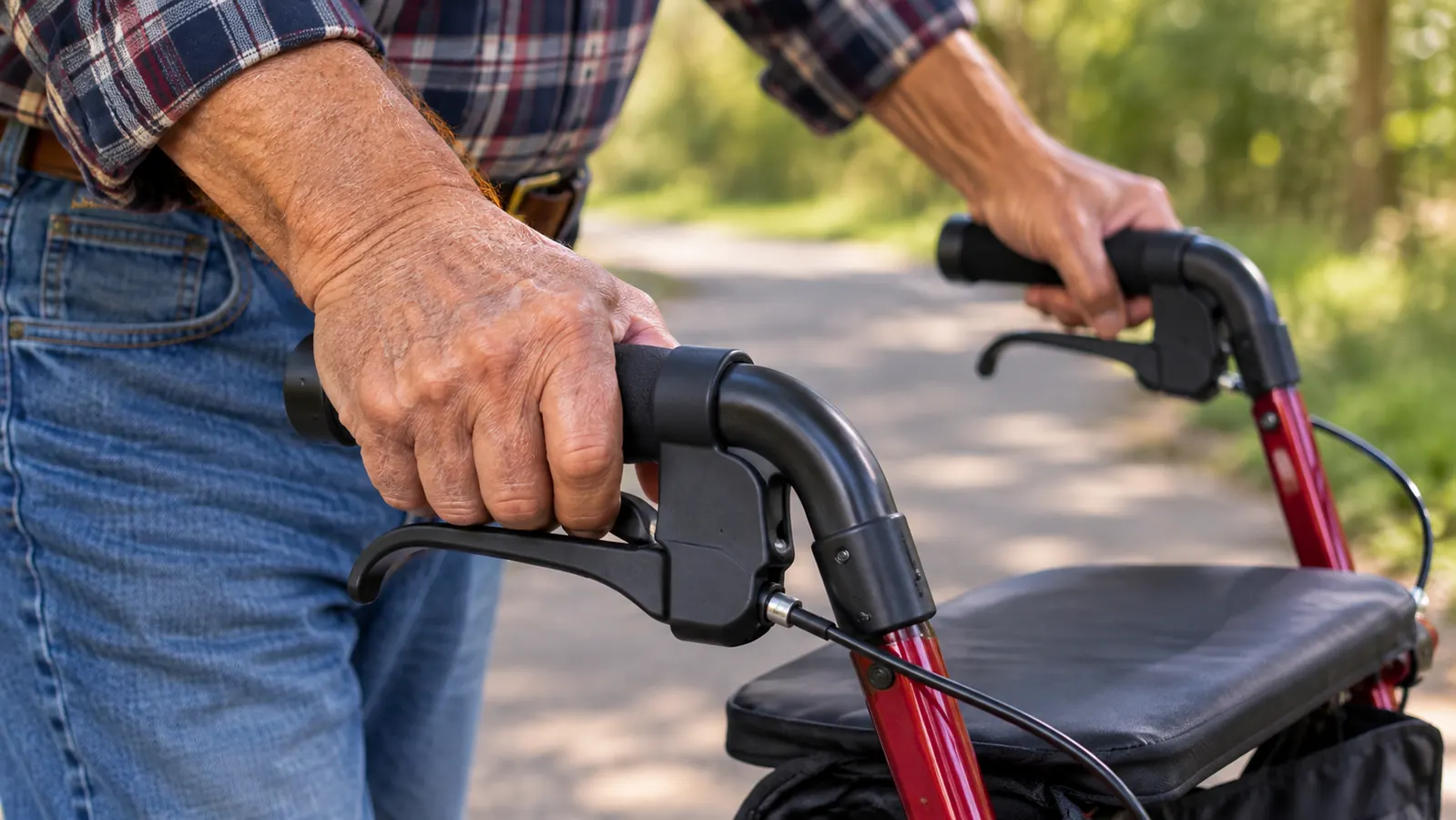
The biggest difference is that the Drive Medical rollator lets me walk like a person instead of like someone carrying furniture. With the standard walker, every step meant lifting the whole frame, setting it down, taking a step, and lifting it again. It works, but it is slow, and after about ten minutes my shoulders and wrists ached from the lifting. The rollator rolls on 7.5 inch wheels, so I just push it along at a normal walking speed. My physical therapist was the one who told me I was ready to make the switch, and she was right. Within a week, I was walking farther, standing taller, and not gripping the handles so hard. The first real test was the grocery store, which is about six blocks from my house. I took the rollator instead of the standard walker, and the difference was night and day. I could keep up with Kathleen instead of making her wait at the end of every aisle. I could carry a small basket on my arm because I was not using both hands to lift. And when my knee started to ache halfway down the frozen food aisle, I set the brakes, sat down on the seat, and waited a minute before finishing the shopping. That was the moment I knew I was not going back.
The seat is the other thing I did not expect to love. With the standard walker, if I got tired at the grocery store, my only options were to lean on the frame or find a bench. With the Drive Medical rollator, I just set the brakes, turn around, and sit down on the seat. It has a fold-up removable back support that I leave up most of the time because it makes the seat feel safer. I use it every single Tuesday at the senior center, where I sit on it while I wait for the Mahjong table to open up. The seat is also why I chose this model over a plain four-wheel walker without one. My doctor and my physical therapist both told me that the ability to sit down before I get too tired is what keeps me from overdoing it. They were right. There have been days at the park where I walked farther than I planned, and knowing the seat was there meant I did not have to turn around early. Last month, I walked the full loop around the park with my neighbor, sat on the seat for five minutes by the duck pond, and walked back. I would not have tried that with the standard walker, because there was nowhere to sit and I would have been stuck.
It folds, which is the other reason it works for me. The frame folds down to about 31.5 by 24.5 by 10.75 inches, and it fits in the trunk of my small sedan without any tricks. I will be honest, at 20 pounds it is not light. I can lift it, but I have to think about it, and on a bad day I ask Kathleen or my neighbor to help. The height adjusts too, which matters more than I expected. My physical therapist set it for me so my elbows sit at a comfortable angle, and there is a lever on the frame that lets me change it if I wear different shoes. The alloy steel frame has held up fine for the 20 months I have had it, with no wobble in the wheels and no looseness in the handles. The warranty is a limited lifetime one, which tells me the company expects it to last.
Where the Standard Walker Wins
I am not going to pretend the standard walker has no place, because it does. In the first weeks after my knee replacement, before I had the strength or the balance to trust wheels, the standard walker was the right tool. It does not roll out from under you. You set it down, you lean on it, and it stays put. That kind of planted, unmoving stability is exactly what you want when you are still learning to stand on a new knee. I remember one night about three weeks after the surgery, I got up to use the bathroom in the dark, and I did not take the walker because I thought I could manage the ten steps. Halfway there, my knee buckled and I grabbed the wall. Nothing bad happened, but it scared me straight. After that, the walker went everywhere with me, and I never tried to skip it again. My physical therapist had me use it until I could walk without wobbling, and I am glad I did. If you are still in the early recovery phase, do not skip this step. Ask your doctor or physical therapist what they recommend. The other thing about those first weeks: everything takes longer than you expect. A trip from the bedroom to the kitchen that used to take twenty seconds took five minutes, because you move the walker, you move yourself, you catch your breath, you move the walker again.
The standard walker is also easier to lift. The Drive Medical rollator weighs about 20 pounds, and while I can get it into my car trunk, I will admit it is a bit heavy for me. Sometimes Kathleen helps, or my neighbor does. The standard walker, by comparison, is light enough to pick up with one hand. If you mostly stay indoors and never need to load an aid into a car, the lighter weight is a real advantage. There is another thing worth saying about the standard walker, and it is the thing nobody tells you: it is exhausting. It is not the walking that wears you out, it is the lifting. Every step, you pick the whole frame up and set it down. On a smooth floor it is fine. On carpet, the rubber tips grab and you have to lift higher. I remember dragging it across the living room rug and thinking there had to be something better. There was. It just was not the right tool for the first stage of healing. And I should say, the standard walker is what I used for those middle-of-the-night trips to the bathroom, when you are groggy and unsteady. The planted legs were a comfort on the way back to bed. I kept my standard walker in the garage for months before I finally cleared it out, and I still think of it fondly, the way you think fondly of a cast after the bone heals. It did its job. It just is not a tool for the life I live now.
The standard walker got me through the healing. The Drive Medical rollator got me back to my life.
The rollator that got me back to Mahjong Tuesdays
If you are past the healing stage and want to get back to errands, park walks, and sitting down when you need to, the Drive Medical rollator with the seat is the one I reach for every day.
Amazon Check Today's Price on Amazon →
Who Should Buy Which
If you are in the first weeks or months after a surgery, or if your doctor or physical therapist has told you to use a standard walker, use the standard walker. It is the most stable thing you can put in front of you, and stability is what healing legs need. You can always graduate to a rollator later, the way I did, once your balance and strength are ready. I would also say this: if you are mostly home, if your trips are from the bedroom to the kitchen and back, and if you do not have a car trunk to load, the standard walker may be all you ever need. It is lighter, it is simpler, and there is nothing on it to break.
If you are past that stage and you want to get out of the house, the Drive Medical rollator is the better fit. It is built for people who have places to go. It rolls smoothly, it has a seat for when you need to rest, and the back support folds up when you want it and removes when you do not. It is not a medical device for recovery. It is a mobility aid for living, and for me, that is exactly what I needed. It is rated for up to 350 pounds, so I never have to think about whether it can handle me, and the height adjusts so you can set it where it feels right. If you are not sure which stage you are in, ask your doctor or physical therapist. They will tell you straight. And if you are somewhere in between, the way I was, remember this: the rollator does everything the standard walker does for me now, and it also lets me sit down when I need to. That is the difference between an aid that gets used and one that stays in the garage.
Ready to trade the shuffle for a walk?
The Drive Medical rollator with the seat is the one I use every day, and the one I would buy again in a second. Check the current price on Amazon and see if it fits your life the way it fits mine.
Amazon Check Today's Price on Amazon →