
Two years ago I had my left knee replaced, and I learned the hard way that a walking cane is only as good as its height. A cane that is too tall makes you lean sideways, ache in the shoulder, and grip the handle like you are hanging on. A cane that is too short makes you stoop, and it makes you feel like you are about to tip forward with every step. I have seen both kinds leaning against the wall in the senior center, and I have left a cane by the door myself. The truth is, most people never check their height. They just grab whatever feels close and live with the ache. A cane that fits, on the other hand, you forget you are holding until you set it down.
My physical therapist set my BeneCane for me about a year ago, and she did it with a method so simple that I have used it on myself every few months since. She had me stand in my tennis shoes on the kitchen floor, let my arm hang loose, and she lined the top of the handle up with the crease of my wrist. That was it. No measuring tape, no chart, no fuss. I am passing that method on here the way I would explain it at the card table. You will need about five minutes, a flat floor, and the shoes you plan to wear with the cane. That is all.
A cane that fits disappears into your day. A cane that does not, you will leave by the door.
The BeneCane adjusts from 31 to 36 inches with a push of a button, so the height is yours in under a minute. It weighs about 12.8 ounces, folds to 17 inches, and it is the cane I reach for on short errands. If you are setting yours for the first time, today's price is easy to check on Amazon.
Amazon Check Today's Price on Amazon →Step 1: Stand the way you will actually walk.
Put on the shoes you will wear most often with the cane. Tennis shoes, walking shoes, whatever you reach for on a normal day. The height is measured from the floor, so thick soles and thin slippers change the number. A cane set in your bare feet will feel different in your walking shoes, and you want the fit to match the way you actually move through your day.
Stand on a level surface, in the kitchen or the hallway, with your weight evenly on both feet. Stand as tall as you comfortably can, the way you would if you were waiting in line at the grocery store. Do not slouch, and do not lean on the counter or the wall. The whole point is to measure the cane against your real standing height, not a propped-up version of it. I do mine in the hallway, where the floor is level and I can see myself in the mirror at the end.
If you are tired or stiff, take a breath and stand tall anyway. The fit has to work for your everyday posture, not your best posture at the doctor's office. And if you land between two holes on the cane, try both and walk a few steps with each. Your shoulder and your balance will tell you which one is right faster than any chart will.
Step 2: Let your arm hang and find the crease of your wrist.
Stand as you did in step one, with your arm relaxed at your side. Do not reach for the cane yet. Let your shoulder drop, and let your hand hang the way it does when you are walking down the sidewalk. Now look down at your wrist and find the small crease where your wrist bends, right where your hand meets your arm. That crease is your mark.
When you hold the cane, the top of the handle should sit level with that crease. Not above it and not below it. This is the line my physical therapist used when she set my BeneCane, and it is the one I still check. It works because it puts your elbow at a natural bend without you having to think about it. If the handle sits above the crease, the cane is too tall. If it sits below, the cane is too short. Simple as that.
The crease method is the one I trust because it does not depend on how long your arm is or how tall you are. It measures the cane against your own body, which is the only ruler that matters. My physical therapist told me to re-check it whenever something felt off, and I have done exactly that every few months since. It takes ten seconds once you know what to look for.
Step 3: Check the bend in your elbow.
Now pick up the cane and hold it the way you will when you walk, with the handle in your hand and the tip on the floor a couple of inches out to the side of your foot. Let your hand rest on the handle the way it naturally does. The BeneCane has a soft foam handle with an offset shape, which means your hand sits over the shaft in a fairly straight line rather than behind it. That is a comfort thing, and it matters more on a long day than you would think. The foam handle is soft enough that I do not think about my grip, even on the days I use it around the house for hours.
Now look at your elbow. It should be bent about 15 to 20 degrees, a comfortable, easy bend. Not locked straight, and not bent like you are holding a tray of drinks. If your shoulder is hiked up toward your ear, the cane is too tall. If your elbow is bent sharply and you feel crowded, the cane is too short. Those two signs are the ones I watch for in the mirror.
The wrist crease and the elbow bend should agree with each other. If they do not, trust the elbow, because that is the joint doing the work all day. A cane that looks right standing still can still be wrong in motion, which is why the walk test in step five matters. Get the elbow right first, and the rest of the day gets easier.

Step 4: Make the adjustment, one button at a time.
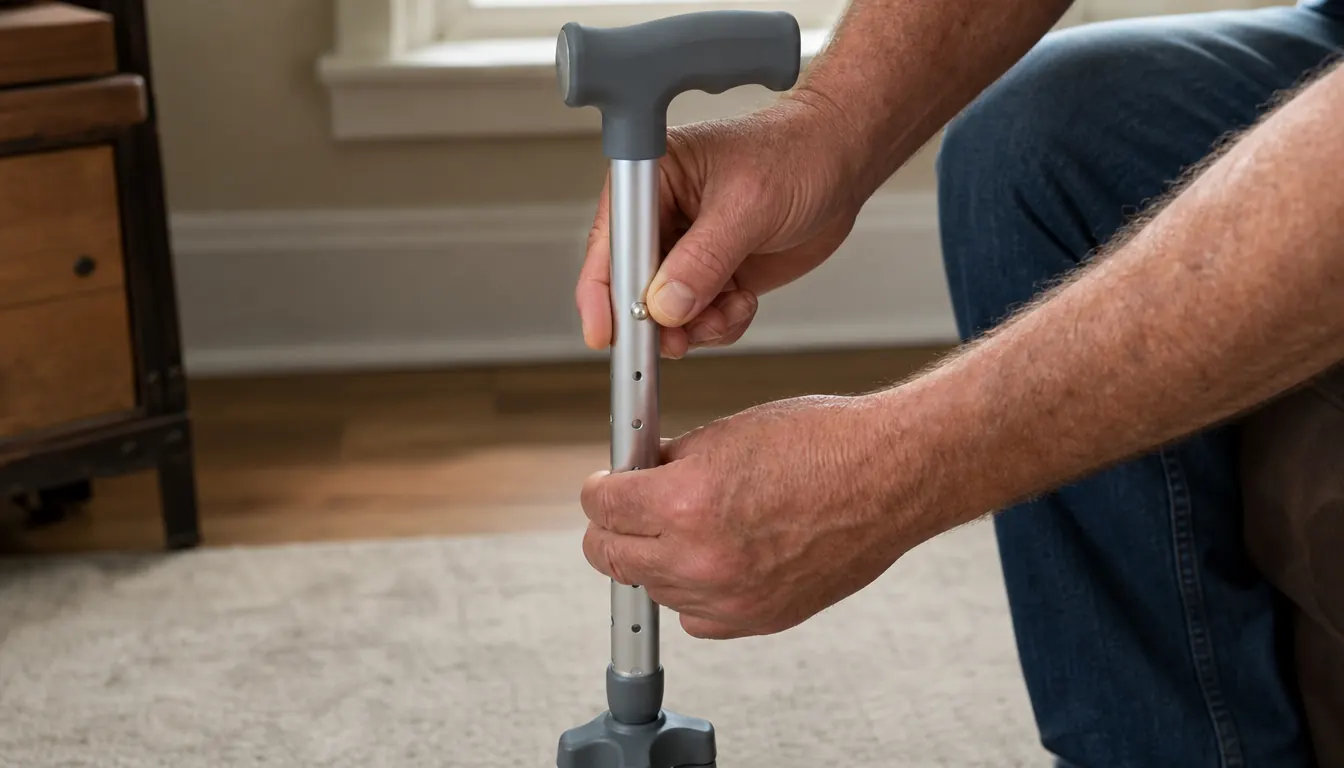
The BeneCane adjusts with a push button on the shaft. Press the button and slide the lower section to the next hole, then release it and make sure it clicks all the way in. The cane adjusts from 31 to 36 inches, so there is room to find your exact setting. Move one hole at a time, about an inch, and re-check against the wrist crease after each move. It is tempting to eyeball it, but the extra ten seconds are worth it.
Once the height is right, tighten the screw collar at the middle joint so the two halves cannot slip, and give the cane a firm tug to make sure everything is locked. Check the rubber tip while you are at it. It should sit flat on the floor, and the tread should still have some life in it. A worn tip is as bad as a wrong height, because both of them steal your confidence with every step.
The whole adjustment takes less than a minute, and you do not need anything but your own two hands. The cane is aluminum, about 12.8 ounces, so it is easy to handle while you work the button. If someone in the house bumps the button and changes the height, you can put it back in seconds. I keep mine at the setting my physical therapist chose, and I check it the same way every time. When I am done, it folds down to 17 inches, which is how it fits in my car trunk and under my chair at poker night.
Step 5: Walk-test it before you trust it.
Put the cane down and walk a few laps around the kitchen or down the hall. Watch yourself in a mirror if you have one. Your shoulder should stay level, and you should not be leaning toward the cane or away from it. The tip should hit the floor at the same time as your opposite foot, and the cane should feel like it is doing the work without you thinking about it. If you are gripping the handle hard, something is off.
The rhythm matters as much as the height. Hold the cane in the hand on your stronger side, so it moves with your weaker leg. For me, that means the cane is in my right hand and it steps with my left leg, the one with the new knee. Up with the good, down with the bad, the old stair rule still holds. The cane leads going down and follows going up, and it keeps me honest on the two steps up to my front porch.
If anything feels off, go back to step two and re-check. Small changes, one hole at a time. And do not just set it and forget it. Check the height again every few months, and any time you switch to a different pair of shoes or notice a new wobble. I check mine before Mahjong Tuesdays, when I know I will be on my feet more than usual, and before I head out to the park on Saturday mornings.
What Else Helps
The right height is the foundation, but a few other habits have kept me steady. Hold the cane in the hand on your stronger side, so it moves with your weaker leg. I hold mine in my right hand because my left knee is the one that needs the help. On stairs, remember the old line: up with the good, down with the bad. The cane goes with the weaker leg, so it leads going down and follows going up. That little rhythm is half the battle.
Ask your physical therapist to check your fit the first time. That is how I got mine right, and it is worth the two minutes. They can watch you walk and catch the small things, like a shoulder that drops or a step that shortens, that you cannot see from the inside. And when the rubber tip starts to look smooth, replace it. A fresh tip grabs the floor the way it is supposed to. Check the screw collar now and then too. It keeps the two halves snug, and it takes two seconds.
And because the BeneCane folds down to 17 inches and weighs about 12.8 ounces, it is easy to take along. Mine goes to Friday poker night, folded small enough to tuck beside my chair, and it rides in the trunk of my car for errands. My daughter Kathleen helped me sort out a lot of the gear I use now, and the cane was the piece we both thought would be the simplest. It turned out to be the one I reach for most.
One more thing. Do not borrow someone else's cane, and do not lend yours. A cane set for one person's height is wrong for another, and the whole point of this exercise is that the height is yours. If you are not sure you have it right, set it down, walk away, and come back to check it fresh. That little reset catches more mistakes than you would expect.
My physical therapist set my BeneCane a year ago with one simple line: the top of the handle belongs at the crease of your wrist. I still check mine against that line every few months.
Set it once, check it twice a year, and get back to your people.
The BeneCane adjusts from 31 to 36 inches with a push of a button, folds to 17 inches, and weighs about 12.8 ounces. It is the cane I reach for on short errands and the one that rides along to poker night. If you are setting yours for the first time, today's price is easy to check on Amazon. Give it the five minutes, and it will give you years of steady steps.
Amazon Check Today's Price on Amazon →