

The moment I knew I needed a bed assist rail came at 3:00 in the morning, about sixteen months after my knee replacement. I woke up needing the bathroom, swung my legs toward the floor, and the new knee just didn't want to cooperate. I caught myself on the nightstand, knocked over a glass of water, and sat back down on the edge of the bed with my heart going. Nothing was hurt, but I sat there thinking: this is how a bad fall starts. The next day I called my daughter Kathleen and told her I was done being stubborn about getting out of bed.
Kathleen found the Lunderg bed assist rail and set it up in about five minutes while I watched. Eight months later, it is still the first thing I touch every morning, and I can tell you exactly what it does and what it doesn't do. This is the long-term review I wish someone had handed me before I bought it.
The Quick Verdict
A sturdy, tool-free bedside rail that makes the hardest part of the day, getting out of bed, feel boring and safe. It is not a full bed rail and it will not lower you to the floor, but for someone who just needs a dependable hand to push against, it has earned its spot on my bed.
Amazon Check Today's Price →A rail you can set up before your coffee gets cold
Kathleen had the Lunderg rail tucked under my mattress in about five minutes, no tools, no swearing. If you or someone you love has had a wobbly morning getting out of bed, this is the fix worth trying first.
Amazon Check Today's Price on Amazon →How I've Used It
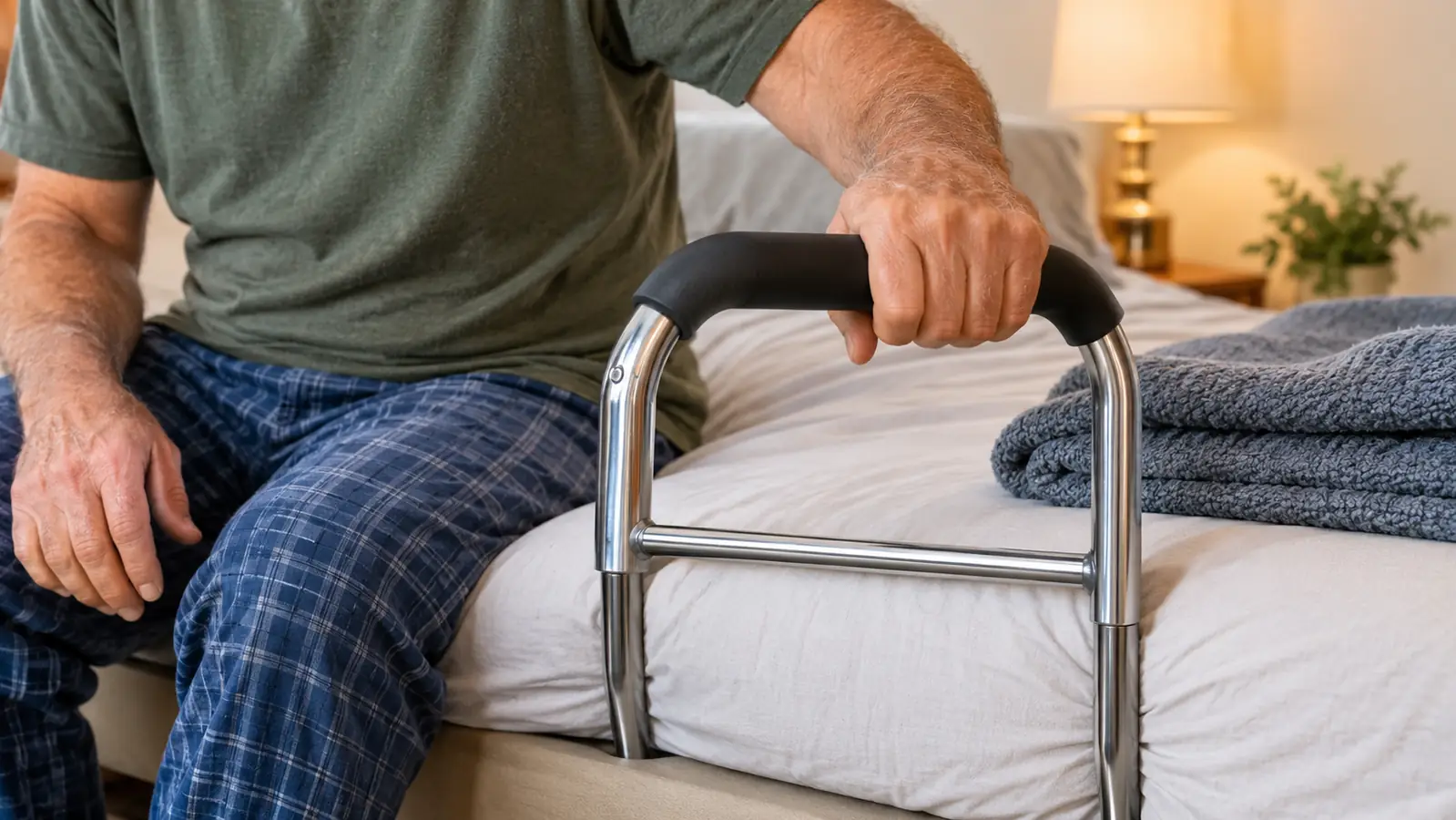
My Lunderg bed assist rail has been on the left side of my bed for eight months now, and it is the rare piece of gear that earned its place within the first week. I sleep on the side closest to the bathroom, so that rail is the first thing I reach for at night and the first thing I grab in the morning. I use it to push myself up from sitting, to steady myself while I find my slippers, and to hold onto for the first two or three steps until my balance wakes up. On a typical morning I swing my legs out, plant both feet, and push off the rail with my right hand while my left hand stays flat on the mattress. It sounds like a small thing, but it is the difference between starting the day steady and starting it braced for trouble.
In the beginning I used it mostly at night, when the house is dark and the knee is stiff from sleeping. Now I use it every single morning, even on good days, because it turns the question of 'can I get up without grabbing the nightstand' into a non-question. I also use it when I make the bed, which I did not expect. Holding the rail with one hand while I smooth the fitted sheet with the other is genuinely easier than my old method of bracing against the mattress. And on Saturday mornings before pickleball, I do a few gentle sit-to-stands using the rail while I wait for my coffee to finish. My physical therapist gave me that idea, and it is a nice way to wake up the knee before I head to the park for the gentle doubles game.
I have not used it as a support for sitting down onto the bed as much as I thought I would. My physical therapist taught me to reach back for the mattress first, so the rail is more of a backup for that move. But for standing up, it is my main thing. The height works for me at 5'4", and the U-shape gives me a natural place to grip without twisting my wrist. The night that sent me shopping for this rail, I grabbed the nightstand and knocked over a glass of water. Eight months later, I have not knocked anything over in the dark since. That is the kind of quiet improvement that does not show up on a chart, but you feel it every single morning. It is also the reason I stopped reaching for the headboard, which was never a good idea on a bed with a padded headboard that moves when you lean on it.
What the Setup Actually Looks Like
The listing says tool-free, five-minute setup, and for once the claim held up. Kathleen drove over on a Saturday morning, and we unpacked it on the bed. The rail arrives partly pre-assembled, which matters more than you might think. There is an adjustable strap that goes under the mattress, and the rail tucks between the mattress and box spring. Kathleen tightened the strap, tested it with her full weight, and that was it. No drawer full of leftover screws, no instruction booklet that assumes you own a workshop, no moment where one of us had to hold a wrench and the other had to read a diagram out loud. The whole thing, from opening the box to leaning on it with her full weight, took about five minutes. Kathleen timed it because she knew I would ask, and I have been telling people the number ever since.
The rail is built from carbon steel, and the listing says it is load-tested to 300 lb. I am nowhere near that number, but I like knowing the margin is there. My daughter is a fair bit heavier than I am, and she leaned on it hard during setup to make sure it would not shift. It did not move. The steel does not flex or groan when I lean on it, and it does not rock side to side the way I half expected a portable rail to do. The non-slip grab bar is the part I touch every day, and after eight months it still has grip. I wipe it with a damp cloth when I change the sheets, which is the entire maintenance routine according to the care instructions, and that has been enough.
One honest note: the rail works on mattresses 7 to 13 inches thick, and mine is right in the middle of that range. The box says the rail itself is 13 inches wide and 13 inches high, and the whole package measures about 25 inches long, so it fits easily on the bed while you are setting it up. If your mattress is very thick or very thin, or if you have an adjustable bed, I would measure before ordering. The strap system is simple, but it needs a mattress it can actually wrap around. Kathleen checked ours with a tape measure before she even opened the box, and that five minutes of measuring saved us from a return.
How It Holds Up Over Months of Daily Use
Eight months is not two years, but it is long enough to see whether a mobility aid is going to get wobbly, and this one has not. The steel frame feels as solid today as it did the afternoon Kathleen installed it. The non-slip grip on the bar has not worn smooth, the strap has not stretched loose, and the rail does not rattle when I lean on it. I tighten the strap maybe once a month when I change the sheets, out of habit more than necessity. It takes about thirty seconds, and honestly I am not sure it needs even that.
The thing that surprised me is how my confidence changed. In the first week I used the rail like a lifeline, gripping it hard and thinking about every move. By the second month I was using it without thinking, the way you use a handrail on a staircase. My physical therapist says that is exactly the pattern she wants to see: the aid becomes background, and the movement becomes automatic. That is what happened for me. I do not wake up and think 'okay, here is the rail, here is my plan.' I wake up, reach out, and my hand lands on the grip before my brain is fully online. That is the whole point of a good mobility aid.
It has also survived a few real tests. There was the morning I woke up disoriented after a late Mahjong Tuesday, when I grabbed it harder than I meant to and pulled myself up faster than I should have. There was the week my hands were stiff from the arthritis and my grip was not what it should have been. The rail held steady through both. There was also the night the power went out during a storm, and I used the rail to find my way along the bed in the pitch dark. I have never once felt it shift under load, and I have never once worried it would. For a piece of equipment that cost what this one costs, that is the review that matters.
The only wear I can find is cosmetic. The grip shows a faint smooth patch where my hand lands every morning, the way a favorite jacket develops a worn spot at the elbow. It has not changed how the rail performs, and the non-slip surface still holds. I mention it because I would rather tell you about a harmless shiny patch than have you discover it yourself and wonder. After eight months of daily use, twice a day at least, that is the entire list of complaints.

What It Is Not
I want to be straight with you about the limits, because the wrong expectations are how good products end up in the garage. The Lunderg bed assist rail is a grab bar, not a full bed rail. It will not keep you in bed, and it will not lower you safely to the floor. If you need a rail that runs the length of the bed, or a transfer aid that helps you stand from the floor, this is not that product. It is also not a substitute for a bed cane or a floor-to-ceiling pole if your balance issues are severe enough that your doctor has recommended something more substantial. I am not a medical professional, and I am not going to pretend to be one. I have a cane for the daytime and a rollator for outings, and the bed rail does a different job than either of them. Knowing which tool does which job is half the battle.
It is also not a replacement for your physical therapist's advice. Mine taught me the right way to get out of bed after my knee replacement, and the rail supports that method rather than replacing it. The rail gives me something to push against, but it does not tell me how to move, and it does not do the work for me. If you are recovering from surgery, ask your doctor or physical therapist about fit and use before you buy. What works for my bed and my body might not work for yours. That is not a disclaimer I am adding to be careful; it is the honest truth about how mobility aids work. The right tool in the wrong setup is still the wrong tool.
What I Liked
- Carbon steel frame load-tested to 300 lb; it has never shifted or rattled under my weight
- Tool-free setup that really took about five minutes, with no small parts or confusing instructions
- Fits mattresses 7 to 13 inches thick and works on either side of the bed
- Non-slip grab bar still has grip after eight months of daily use
- Easy to clean: a damp cloth when I change the sheets is the whole routine
Where It Falls Short
- It is a grab bar, not a full bed rail; it will not keep you in bed or help you up from the floor
- Needs a mattress in the 7 to 13 inch range, so measure before you order
- Not designed for adjustable beds, so check your frame first
- The strap needs a quick monthly check when you change the sheets
Eight months in, the rail has not shifted, rattled, or worn smooth. The only thing that changed is that I stopped thinking about it, which is exactly what a good mobility aid should do.
Who This Is For
This rail is for someone who has had a wobbly moment getting out of bed and wants a dependable hand to hold onto before it becomes a fall. It is for the person who is tired of grabbing the nightstand, the headboard, or the lamp. It is for the spouse who watches their partner struggle out of bed and wants to do something useful about it. And it is for anyone with a new knee, a new hip, or a balance issue that is worse in the dark, because 3:00 in the morning is when steadiness matters most.
Who Should Skip It
Skip it if you need a full bed rail that contains you while you sleep, or if you need help transferring from the floor. Skip it if your mattress is outside the 7 to 13 inch range, or if you have an adjustable bed that the strap cannot wrap around. And skip it if you are looking for something you never have to think about at all, because every mobility aid needs a moment of attention now and then. The Lunderg rail asks for very little, but it asks for a monthly strap check and a wipe-down with a damp cloth.
The first steady step of the day, for less than you'd expect
Eight months in, I reach for my Lunderg rail without thinking, and that is the whole point. If you or someone you love has had a wobbly morning, today is a good day to stop grabbing the nightstand.
Amazon Check Today's Price on Amazon →