

Two years past a knee replacement, I still have mornings where my first thought at 3 a.m. is not about my knee. It is about the transfer: swing the legs out, find something solid to push against, and stand without grabbing the nightstand and pulling a lamp down. That is the exact moment a bed assist rail and a bed ladder answer two different questions. The Lunderg bed assist rail gives you a rigid U-shaped steel bar to push against. A bed ladder gives you fabric rungs to pull yourself up by. One is built for getting out of bed. The other is built for getting up from lying flat. I have lived with the Lunderg for about eight months, and I borrowed a neighbor's bed ladder for a few weeks to compare the two honestly. Here is what I learned.
The short answer: if your hard moment is the first step out of bed, buy the rail. If your hard moment is hauling yourself up from flat on your back, a bed ladder does something the rail cannot do. And if you are like my friend at the senior center, you may end up wanting both. But they are not the same tool, and picking the wrong one means you will still be reaching for the nightstand at 3 a.m.
| Lunderg Bed Assist Rail | Bed ladder | |
|---|---|---|
| Best for | Getting in and out of bed, and the first steady step of the morning | Pulling yourself up from lying flat when your core is weak |
| Getting out of bed | Rigid non-slip grab bar gives you a fixed surface to push against | You pull upward on the rungs; less help for the swing-and-stand move |
| Getting up from flat | Helps you roll to your side, but it is not a pull-up aid | Hand-over-hand on the rungs hauls you up to sitting |
| Sturdiness | Heavy-duty carbon steel, load-tested to 300 lb, tucks under the mattress | Webbing and straps are sturdy but move with the mattress |
| Setup | Tool-free, about 5 minutes, arrives partly pre-assembled | Simple to attach, but depends on having a footboard or frame |
| Fit | Twin to king, mattresses 7 to 13 inches, either side of the bed | Needs a footboard, headboard post, or bed frame to attach to |
| One-handed use | Grab the bar with one hand while the other holds your cane | Takes two hands to climb the rungs |
| Portability | 1.4 kg steel rail; it stays under the mattress | Folds small enough for a suitcase or a guest room closet |
| Cost of entry | A one-time purchase built to last | Typically the lower-cost option |
| Care | Wipe with a damp cloth | Webbing can be wiped or laundered per the maker's instructions |
How I Compared Them
Eight months ago, I had a wobbly moment getting out of bed in the dark. My daughter Kathleen ordered the Lunderg bed assist rail, and she had it set up in about five minutes with no tools. It arrives partly pre-assembled, tucks under the mattress, and uses an adjustable strap to hold it in place. It works on either side of the bed and fits mattresses from twin to king, 7 to 13 inches. That universal fit mattered to me because I did not want to measure anything, buy a special frame, or call a handyman. I wanted something that worked with the bed I already had.
For the comparison, I spent a few weeks using a simple fabric bed ladder that attaches to the footboard. I wanted to know which tool helped with which movement, and whether one could replace the other. I tested both on the same bed, same mornings, and I kept notes on the movements my physical therapist calls the hard transfers: lying to sitting, sitting to standing, and the first few steps after you stand. I also paid attention to the middle-of-the-night test, because that is when good judgment goes out the window and habit takes over. One Tuesday before Mahjong, I timed the whole transfer on each tool. With the rail, I was standing in about twenty seconds. With the ladder, I needed closer to a minute, and I still reached for the nightstand once my feet hit the floor. That single morning told me more than any product page, because it showed me exactly which movement each tool solves.
What I Liked
- Rigid carbon steel frame, load-tested to 300 lb, does not flex when you push against it
- Tool-free setup in about five minutes; arrives partly pre-assembled
- Universal fit: twin to king, mattresses 7 to 13 inches, either side of the bed
- Non-slip grab bar gives a fixed handhold in the dark
Where It Falls Short
- Does not help you pull up from lying flat; that is a bed ladder's job
- Steel rail stays under the mattress; it is not something you pack for a trip
- Fits mattresses 7 to 13 inches, so measure yours before ordering
What the Rail Actually Feels Like
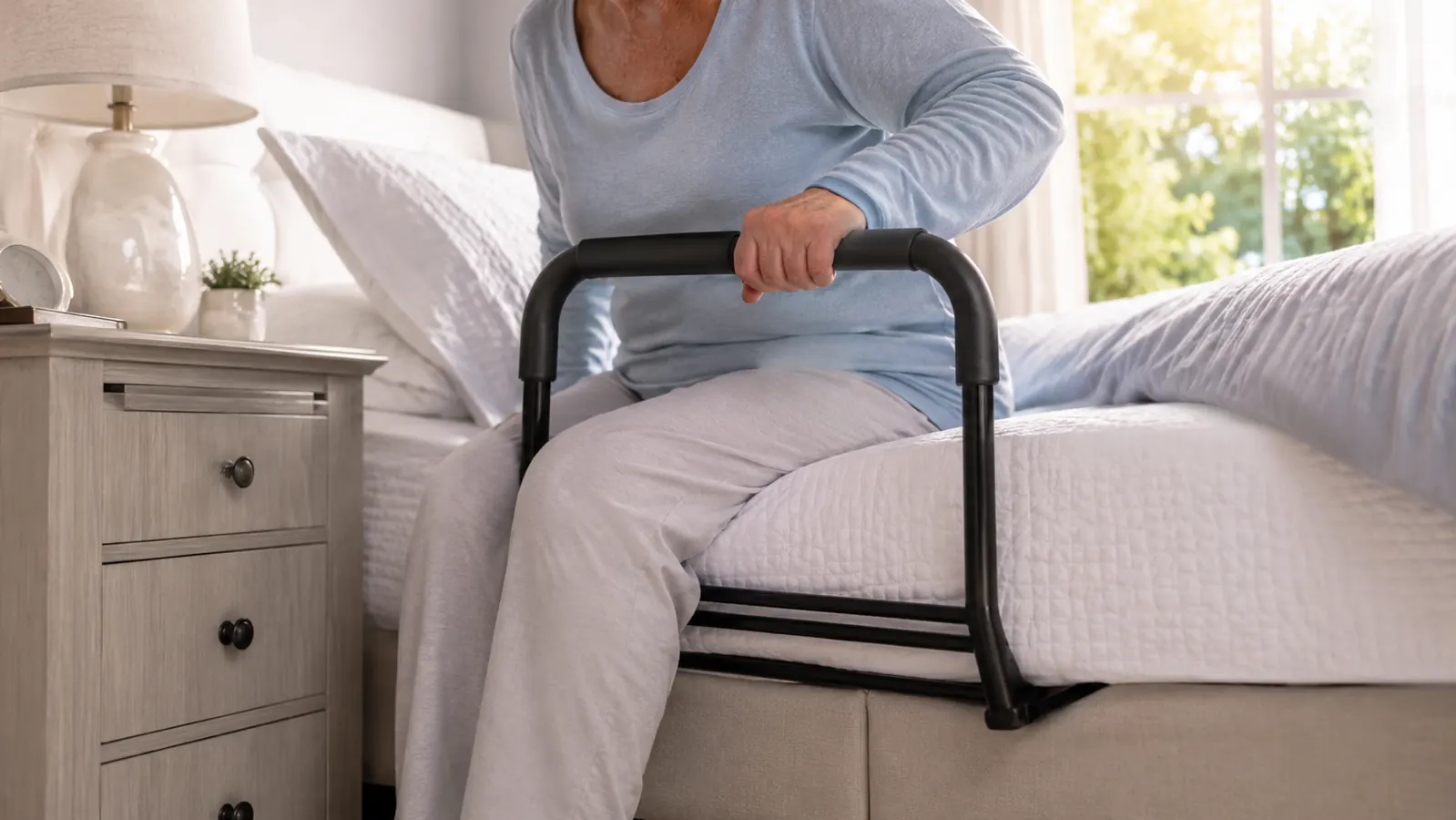
The first thing you notice is how solid it feels. The Lunderg is carbon steel, load-tested to 300 lb, and it does not flex when you lean on it. It is U-shaped, with a non-slip grab bar across the top, and at 13 inches it sits low enough that I can grip it while my feet are still on the floor. In the dark, I can find it without looking. That sounds like a small thing until you have stood at the edge of the bed at 3 a.m. with one hand on the wall and no idea where the lamp is. The bar is right there, exactly where I expect it, every single night. One night in April I woke up at 2 a.m. with a cramp in my left leg. I put my palm on the bar, pushed myself upright, and stood at the bedside until it passed, no lamp, no call to Kathleen. That was the night I stopped thinking of it as a gadget and started thinking of it as part of the room.
It is also quiet, which I did not expect. The adjustable strap holds it snug against the mattress, so it does not rattle or shift when I move in my sleep. Kathleen set it up in about five minutes, and I have not touched it since. When I need to change the sheets, I lift the mattress edge, pull the rail out, and put it back when I am done. The whole thing takes less than a minute, and it goes back exactly where it was.
Where the Lunderg Wins
The Lunderg wins the moment that matters most to me: getting out of bed. The non-slip grab bar is a fixed point. I push against it to swing my legs out, then I use it again to steady myself before I stand. Because it is heavy-duty carbon steel load-tested to 300 lb, it does not flex or shift the way a strap does. I trust it with my full weight on a bad morning, and that trust is the whole point of a mobility aid. It turns a scary transfer into a routine one, and routine is what builds confidence.
It also wins on setup and fit. No tools, no small parts, no confusing instructions. It fits twin to king and mattresses 7 to 13 inches, works on either side of the bed, and the adjustable strap means it does not wander. I keep it on the side where I get out for my morning routine. If I ever need it on the other side, I can move it myself without calling Kathleen for help. That independence matters more than I expected it to.
The rail does not pull you up. It gives you something solid to push against, and for my knee that was the piece I was missing.
Where the Bed Ladder Wins
I have to be honest: the bed ladder won the lying-to-sitting test. If your hardest movement is getting from flat on your back to sitting up, a ladder gives you something a rail cannot. You grab the rungs and pull yourself up hand over hand. That is a real advantage if your core is weak, or if you are recovering from surgery and cannot do a sit-up. My neighbor uses hers every morning for exactly that reason, and after two weeks with it, I understood why. One morning I woke up flat on my back and, instead of rolling to my side the way I do with the rail, I grabbed the top rung and pulled. Three pulls got me upright, and my knee never had to do the heavy work. For anyone with a tender joint, that is a real difference, and it is the reason I cannot call the ladder a waste of money.
The ladder also wins on portability and cost of entry. It folds down to almost nothing, so it is easy to store in a closet, take to a cabin, or keep in a guest room for visitors. It is typically the lower-cost option too, which makes it an easier thing to try if you are not sure you need a rail long-term. For a traveler or someone testing the waters, that is a genuine advantage, not a small one. You are not committing to a piece of steel in your bedroom.
For a steady push-off surface, the Lunderg rail is the one I kept
Eight months in, the Lunderg bed assist rail is still under my mattress, and I use it every single morning. It is the tool that solved my 3 a.m. moment. Check today's price on Amazon and confirm the fit for your bed.
Amazon Check Today's Price on Amazon →
Who Should Buy Which
Buy the Lunderg bed assist rail if getting out of bed is your hard moment: the swing, the push, the first step. That was my problem, and the rail fixed it. Buy a bed ladder if lying flat is the problem and you need to pull yourself up. And if you are not sure, ask your physical therapist which movement is actually hard for you. That answer tells you which tool you need better than any product page will.
A few people I know use both: a rail on the side they get out of, a ladder on the other side for the nights when they wake up flat on their back and need to haul themselves up. That is not a waste of money if both movements are hard. But if I had to choose one for my mornings, it is the rail. The first step out of bed was my wobbly moment, and the rail is what steadied it. The ladder went back to my neighbor, and I do not miss it.
The Honest Tradeoff
Here is what nobody tells you: neither tool fixes everything. The Lunderg rail is superb for the push-off, but it does not pull you up from flat. The bed ladder is superb for the pull-up, but it does not give you a rigid push surface for standing, and it needs a footboard or frame to attach to. If your bed has no footboard, the ladder may not work at all, and that alone settles the question for a lot of people. It settled it for me.
For me, the deciding factor was the 3 a.m. moment. I needed something solid to push against in the dark, without fumbling for a light switch or reaching for furniture that could tip. The Lunderg is exactly that. It is the difference between waking up already braced for the hard part and waking up knowing the hard part is handled. That is not a small thing when you are 72 and your balance is not what it used to be.
What to Check Before You Buy
Before you order, check three things. First, your mattress height: the Lunderg fits mattresses 7 to 13 inches, so measure yours if you are not sure. Second, which side of the bed you get out of; the rail works on either side, but you want it on the side you actually use. Third, ask your doctor or physical therapist about fit and use, especially if you have balance concerns. That is the same advice I give everyone at the card table, and it is the advice I wish someone had given me. The other thing I would tell you is to measure before you order. I got out a tape measure and checked my mattress against the 7 to 13 inch range, and I looked at the 1.4 kg weight so I knew I could handle the rail myself when changing sheets. Two minutes of measuring saved me the trouble of a return.
And one note on the ladder: make sure your bed has a footboard, headboard post, or frame you can attach it to. A platform bed with no footboard is a dead end for a ladder. The rail does not care; it tucks under the mattress and the adjustable strap holds it. That universal fit is why the Lunderg ended up in my house and the ladder went back to my neighbor. It works with the bed I have, not the bed I would need to buy.
The Bottom Line
The bottom line: the Lunderg bed assist rail and a bed ladder are both good tools, but they solve different problems. The rail is for the push-off and the first step of the morning. The ladder is for pulling yourself up from flat. I kept the rail. If your mornings start with the same wobbly moment mine did, I would start there, and I would ask your doctor or physical therapist before you order anything.
The rail that steadied my 3 a.m. moment
If getting out of bed is your hard part, the Lunderg bed assist rail is worth a look. It set up in five minutes with no tools, and it has been under my mattress every morning for eight months. Check today's price on Amazon.
Amazon Check Today's Price on Amazon →