
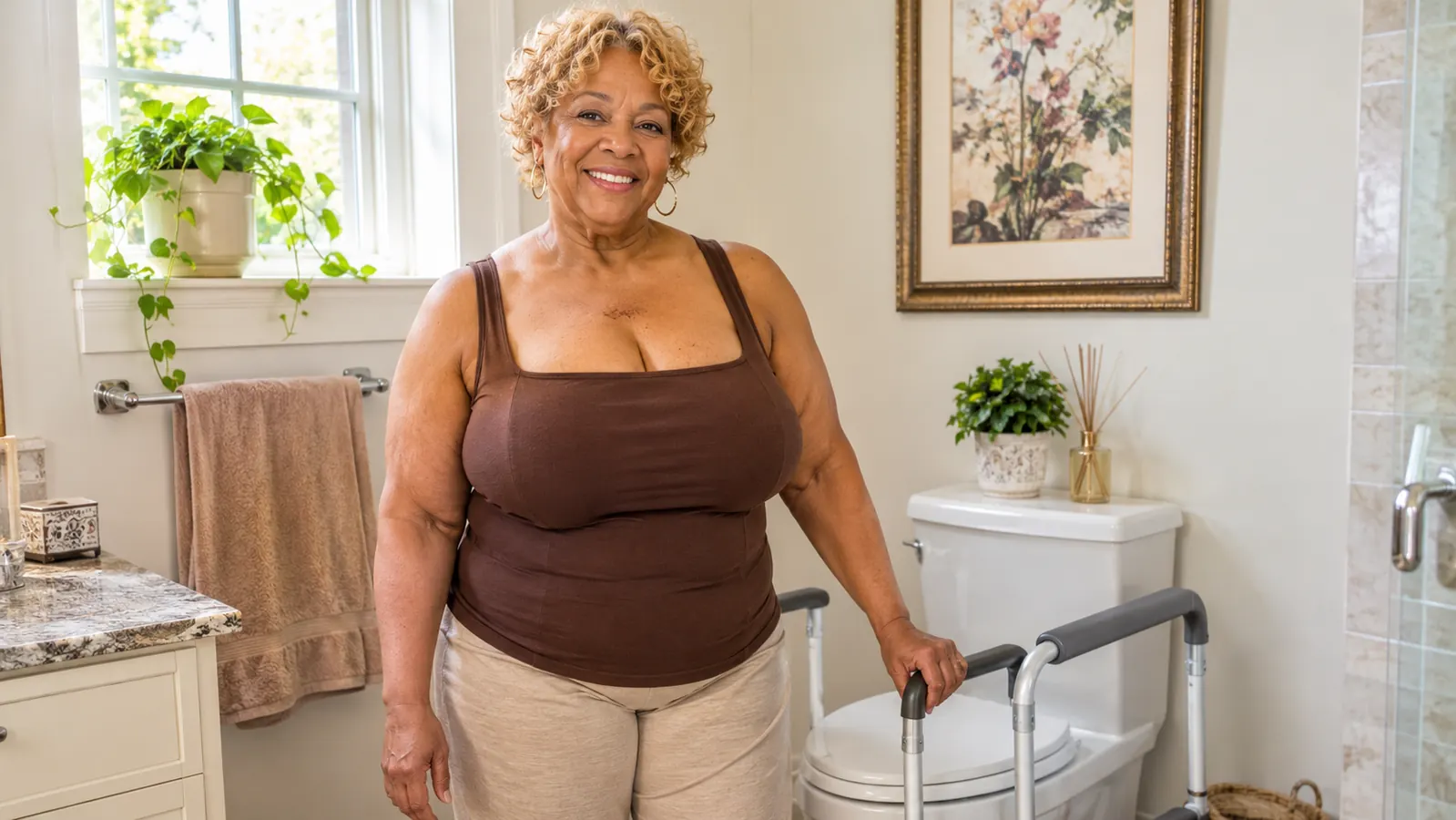
Two years ago, sitting down and standing up from the toilet was the hardest part of my day. My left knee was newly replaced, my balance was shot, and I gripped the edge of the sink so hard my knuckles went white. My physical therapist told me to stop reaching for the towel bar before I pulled it out of the wall, and to look into a toilet safety rail instead. I bought the Medline toilet safety rail about 22 months ago, and it is still in place and used every single day. This is the long-term review I wish someone had handed me before I ordered it.
The Medline is an adjustable aluminum rail that fits around the toilet and gives you two padded armrests to push down on when you sit and stand. It is not a raised toilet seat, and it is not a grab bar bolted to the wall. It is the thing that turns a scary moment into a normal one. If you are trying to decide whether one of these belongs in your bathroom, here is what two years of honest use looks like.
The Quick Verdict
After 22 months of daily use, the Medline toilet safety rail is the most reliable piece of recovery gear I own. It is sturdy, easy to clean, and simple to adjust, and I would buy it again without hesitating.
Amazon Check Today's Price →The rail that made the bathroom feel safe again
Two years in, the Medline toilet safety rail is still the first thing I touch every morning. If you or someone you love is struggling with sitting and standing, this is the rail I recommend. Check today's price on Amazon and see if it fits your toilet.
Amazon Check Today's Price on Amazon →How I've Used It
My house in Watsonville is a single-story place with two steps up to the front porch, and the bathroom is at the end of the hall. When I came home from the hospital after my knee replacement, the toilet might as well have been on the moon. Sitting down felt like falling, and standing up felt like a math problem I could not solve. My daughter Kathleen helped me install the Medline rail about a week after surgery, and it took us maybe ten minutes to get the height right.
Kathleen read the directions out loud while I sat on the edge of the tub and told her which height felt right. We started with the armrests too low, and I had to lean sideways to reach them, which made my back complain. Then we set them too high and I felt like I was reaching up for a pull-up bar. The middle setting, with the armrests just above elbow height when I stood, was the one that worked. My physical therapist had told me the armrests should be high enough that I push down with straight arms, not bent ones, and that rule of thumb is what finally got it right. We tested it the same way Kathleen tests everything: she pushed down on both armrests with her full weight, then made me do it, and only then did she let me use it for real.
The rail adjusts from 27.5 to 31.5 inches in height, and the width between the arms adjusts from about 18 to 24 inches. We set the armrests just above the height my physical therapist recommended for my new knee, so I am pushing down through my arms instead of torquing my leg. The aluminum frame weighs only 4.4 pounds, which matters more than you would think, because it means I can lift it out of the way when Kathleen runs the vacuum or when I need to get the mop behind the toilet.
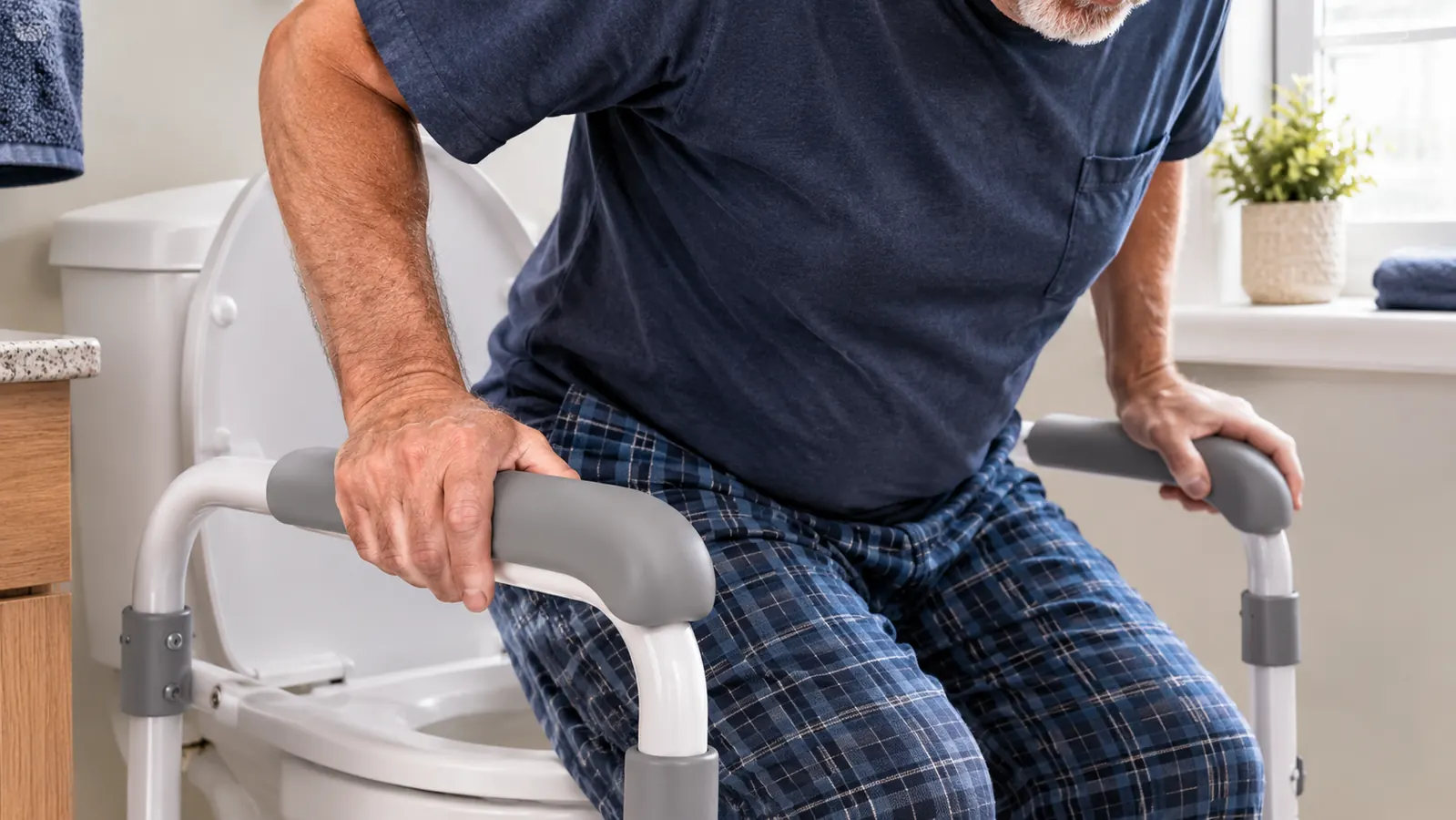
I use it the same way every day. I walk in, turn around, reach back for both armrests, and lower myself down slowly with my arms taking most of the weight. Standing up is the same motion in reverse: hands on the armrests, push, and let my legs do the rest. It took me a few weeks to stop gripping the armrests like they were going to disappear, and a few months before I stopped thinking about the motion at all. On Mahjong Tuesdays, when I am rushing to get out the door, the rail is the one thing I never have to think about. I can be half awake and still do the motion without a wobble. That is the highest compliment I can pay a piece of mobility gear. That is the real review. The rail did not just help me use the toilet. It helped me stop being afraid of my own bathroom.
What the Medline Rail Actually Does
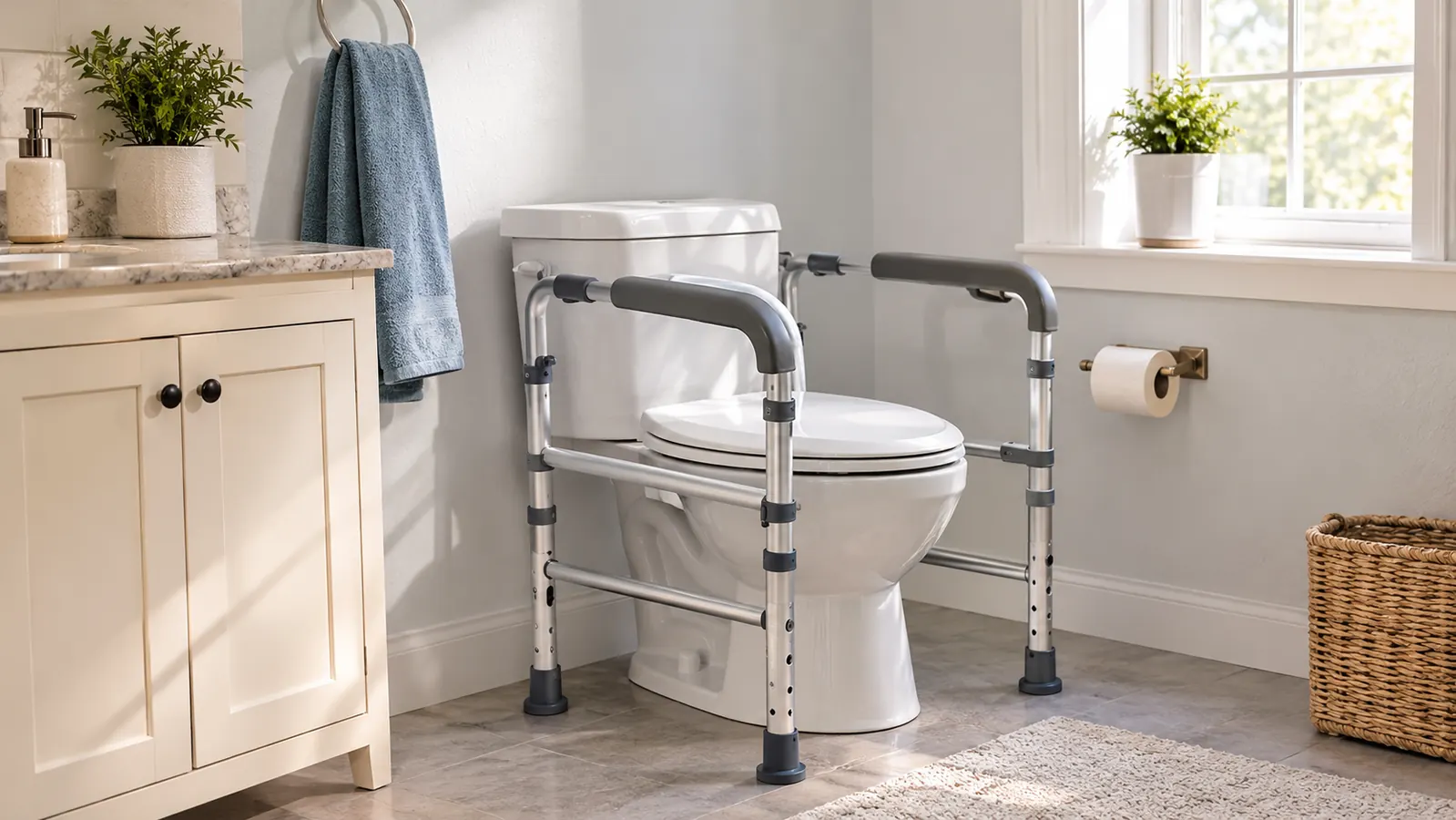
The Medline toilet safety rail is a foldable aluminum frame that sits around your existing toilet. It has padded armrests on both sides, a scratch-resistant powder coating, and a design that is meant to fit most standard toilets. The listed dimensions are 27.5 to 31.5 inches long, 19 to 22 inches wide, and 27.5 to 31.5 inches high, with a seat depth of 16.75 inches. When it is folded, it takes up almost no room at all, which is why I can tuck it behind the door when I need the space. The weight rating is in the listing, and I always tell people to check it before they buy, because the exact number matters for your specific situation.
The armrests are the whole point. They are padded, which sounds like a small thing until you are putting your full weight through your hands twice a day. The padding is firm enough to give you a stable grip and soft enough that it does not dig into your palms. My hands are not what they used to be, a little arthritis in both, and I have never once felt like I was going to lose my grip. I have a habit of checking the armrests every few weeks, pressing down hard to make sure nothing has loosened, and two years in they feel exactly the way they did the first week. The coating has not chipped anywhere, which surprised me, because I expected the metal to show wear by now. And one morning about a year ago, when I caught my foot on the bath mat and grabbed the armrest hard to steady myself, the rail did not shift at all. That is the kind of moment that shows up in the second year, and the Medline handled it without a complaint.
The frame is aluminum, so it will not rust in a damp bathroom, and the powder coating means it wipes down in about ten seconds with a disinfectant wipe. I keep a pack of disinfectant wipes on the back of the toilet, and every Sunday I wipe down the armrests and the frame while I am already in the room. It takes less time than brushing my teeth, and it means the rail is always ready for whoever needs it, including Kathleen when she visits. That matters more than you might expect. Bathrooms are damp, and anything with a steel frame and a painted finish starts to show it within a year. The Medline still looks the way it did the day Kathleen and I set it up.
Two Years of Daily Use: The Long-Term Picture
Here is what nobody tells you about recovery gear: the first month is easy to review, because you are using it every hour and you notice everything. The hard part is the second year, when you are feeling better and you start to wonder whether you still need the thing. I asked my physical therapist about that around the 18-month mark, and she said the question was not whether I needed it, but whether removing it made my life better. She also pointed out that my balance is not what it was before the surgery, especially when I am tired, and that the rail costs me nothing to keep. Removing it does not. So it stays.
The rail has held up with zero problems. No loose joints, no wobbly armrests, no rust, no peeling coating. The height adjustment still clicks into place the way it did on day one, and the fold mechanism still works smoothly. I fold it up when Kathleen visits and we need the extra space in the bathroom, and it takes about five seconds. There was one morning, about six months in, when I woke up stiff and tired and my knee simply would not cooperate. I sat down too fast, lost my balance, and grabbed the armrest at the last second. The rail took my full weight without a sound. I sat there for a minute with my heart pounding, and then I laughed at myself, because the thing I had been afraid of had happened, and the rail had simply caught me. That is when I stopped thinking of it as recovery gear and started thinking of it as furniture.
The one thing I would change is the width. The rail fits my toilet fine, but if you have a very small bathroom or an unusual toilet shape, it is worth measuring before you order. The width between the arms adjusts from about 18 to 24 inches, which covers most standard toilets, but check your own setup. The last thing you want is to open the box and discover the rail does not fit, because returning a product with over 25,000 reviews is not how you want to spend your afternoon.
The rail did not just help me use the toilet. It helped me stop being afraid of my own bathroom.
The Tradeoffs Nobody Mentions
Let me be straight with you. The Medline toilet safety rail is not the most beautiful thing in my bathroom. It is a piece of medical equipment, and it looks like a piece of medical equipment. My friend Carol asked me once whether I had thought about getting one of the wooden ones that looks like a piece of furniture, and I told her the truth: I thought about it for about four seconds, and then I remembered that the point of this thing is to keep me from falling, not to win a decorating award.
The other tradeoff is that it takes up space. The width between the arms adjusts up to about 24 inches, which is comfortable for me, but it means the rail sticks out a few inches on each side of a standard toilet. My bathroom is at the end of the hall, and the rail sits closest to the door, so I have learned to turn sideways when I walk past it. Kathleen bumped her hip on it the first time she visited after we installed it, and we both laughed. It is not a problem, but it is the kind of thing you want to know before you order, especially if your bathroom is on the small side.
And the third thing is the one I almost never see in reviews: the rail does not help you with the rest of the bathroom. It helps with sitting and standing, and that is it. You still need to think about the shower, the sink, and the path between them. I have a non-slip mat and a shower chair that I bought separately, and I use all of it. The rail is one tool in a toolbox, not the whole toolbox.
What I Liked
- Sturdy aluminum frame with a weight rating you can verify in the listing
- Padded armrests are comfortable and give a secure grip
- Height adjusts from 27.5 to 31.5 inches to fit most users
- Folds flat for storage and weighs only 4.4 pounds
- Scratch-resistant powder coating is easy to wipe clean
- Easily fits most standard toilets
Where It Falls Short
- Takes up a few inches on each side of the toilet
- Looks like medical equipment, not furniture
- No built-in night light or storage
- You still need to measure your toilet before ordering
Who This Is For
The Medline toilet safety rail is for anyone who has ever gripped the sink and held their breath before sitting down. It is for the person who just had a knee or hip replaced, the person whose balance is not what it used to be, and the person who is tired of asking their spouse to stand outside the bathroom door just in case. It is for my neighbor Frank, who had a stroke two years ago and will not admit that he uses the one I recommended to his daughter. It is for the version of me from 22 months ago, who needed something to hold onto and did not know where to start.
If you are the person helping a parent or a spouse figure this out, this is also for you. Kathleen did the research for me, and she told me later that she picked the Medline because it had thousands of reviews, a weight rating she could verify, and a price that did not make her wince. She was right on all three counts. The rail is the kind of purchase you make once and then forget about, in the best possible way.
Who Should Skip It
Skip the Medline toilet safety rail if you have a toilet that is unusually shaped, a bathroom so small that a few extra inches on each side will be a problem, or a situation where you need more support than a rail can give. If you cannot stand without help, or if your doctor or physical therapist has told you that you need a higher level of support, a raised toilet seat with arms or a commode might be the better answer. Ask your doctor or physical therapist about fit and use before you buy. I say that to everyone, and I mean it.
I would also say: if you are early in your recovery and still using a walker everywhere, you might not need this yet. My physical therapist had me stick with the standard walker for the first few months, and the rail came later, when I was moving around the house more but still not steady enough to trust my legs for the sitting and standing motion. There is no prize for buying everything at once. Buy what you need when you need it.
Still the first thing I touch every morning
Two years after my knee replacement, the Medline toilet safety rail is still doing its job without a single complaint. If you are ready to stop gripping the sink, check today's price on Amazon and see if the Medline is the right fit for your bathroom.
Amazon Check Today's Price on Amazon →