

Two years ago, before my left knee replacement, I bought a raised toilet seat. It seemed like the obvious answer. The toilet was low, my knee was shot, and everyone I knew who had surgery talked about how hard the bathroom was. The raised seat helped for about a week. Then my physical therapist watched me use it and said what I needed was something to push against, not just a few extra inches of height. That is when I switched to the Medline Toilet Safety Rail, and it is the one I have used every day since.
Here is the short answer to the question in the title: if your problem is standing up from the toilet, get the rail. If your problem is simply that the toilet sits too low and your arms are strong, the raised seat is cheaper and it works. Most active seniors I know, including me, need the rail. I will show you exactly how I figured that out.
The short answer: The Medline rail wins for anyone who needs help getting up from the toilet. The raised seat only wins if your only problem is seat height and you have solid arm strength.
How I Compared Them
I am 72, I live alone in a single-story house in Watsonville, and I had my left knee replaced about two years ago. I also have mild arthritis in my hands, which matters more than you would think. Grips that need a lot of hand strength are useless to me. I tried the raised toilet seat first, before surgery, and then the Medline rail after. Each one got weeks of honest use, not a five minute sit-down test.
A note before I go further: I am not a doctor or a physical therapist. I am a retired dental office manager who learned the hard way which bathroom aids actually help. What worked for me may not work for you, so ask your doctor or physical therapist about fit and use. Everything below is just my experience, shared the way I would at the card table.
I also want to be clear about the timeline. I bought the raised seat before my surgery, when I was still guessing about what I would need. The Medline rail came about a week after surgery, once my physical therapist saw me struggling. The rail has been in my bathroom for about 22 months now. The raised seat has been in the hall closet for almost all of that time. That is the honest scoreboard.
I remember the exact morning I gave up on the raised seat. It was about a week after the surgery. I had slept badly, my knee was stiff, and when I went to stand up I caught myself gripping the edge of the sink with one hand and the door frame with the other. My physical therapist had already pointed out the problem the day before. The seat gave me height, but it gave me nothing to push against. I ordered the rail that same morning.
| Medline Toilet Safety Rail | Raised Toilet Seat | |
|---|---|---|
| Cost | One-time purchase, no extra parts to buy | Usually the lower-cost option |
| Setup | Fits most toilets, folds flat against the toilet when not in use | Lifts off in seconds, but you have to match it to your bowl shape |
| Standing up help | Padded armrests give you something to push down on | Adds height so you do not sink as far, but there is nothing to grip |
| Seat height | Your toilet seat height stays the same | Adds a few inches so there is less distance to lower yourself |
| Adjustability | Adjustable height from 27.5 to 31.5 inches | Fixed height, usually just one size |
| Fit | Width between arms adjusts from 18 to 24 inches | Depends on your toilet bowl shape |
| Storage | Folds flat, about 4.4 pounds, tucks behind the door | One solid piece, harder to put away |
| Guests | Stays in place, always ready when you need it | Lifts off so guests see your regular toilet |
| Best for | Anyone who needs help both sitting down and standing up | Someone who mainly needs extra height and has good arm strength |
Where the Medline Toilet Safety Rail Wins
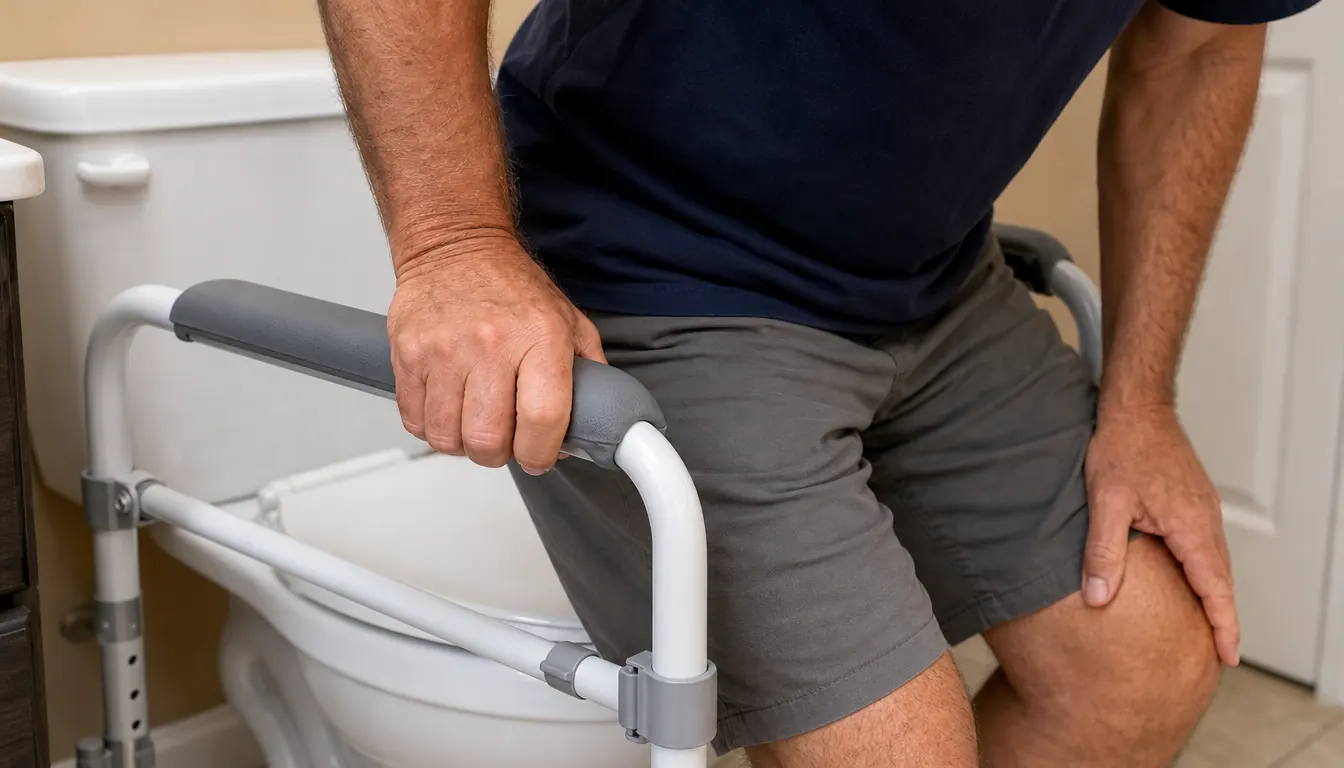
The biggest difference is the armrests. With the raised seat, I still had to push myself up with my legs, and my new knee did not want the job. With the Medline rail, I put one hand on each padded armrest and my arms do most of the work. My hands are arthritic, and the padding makes a real difference. A hard plastic grab bar hurts after the third or fourth time in a day. The padded armrests do not.
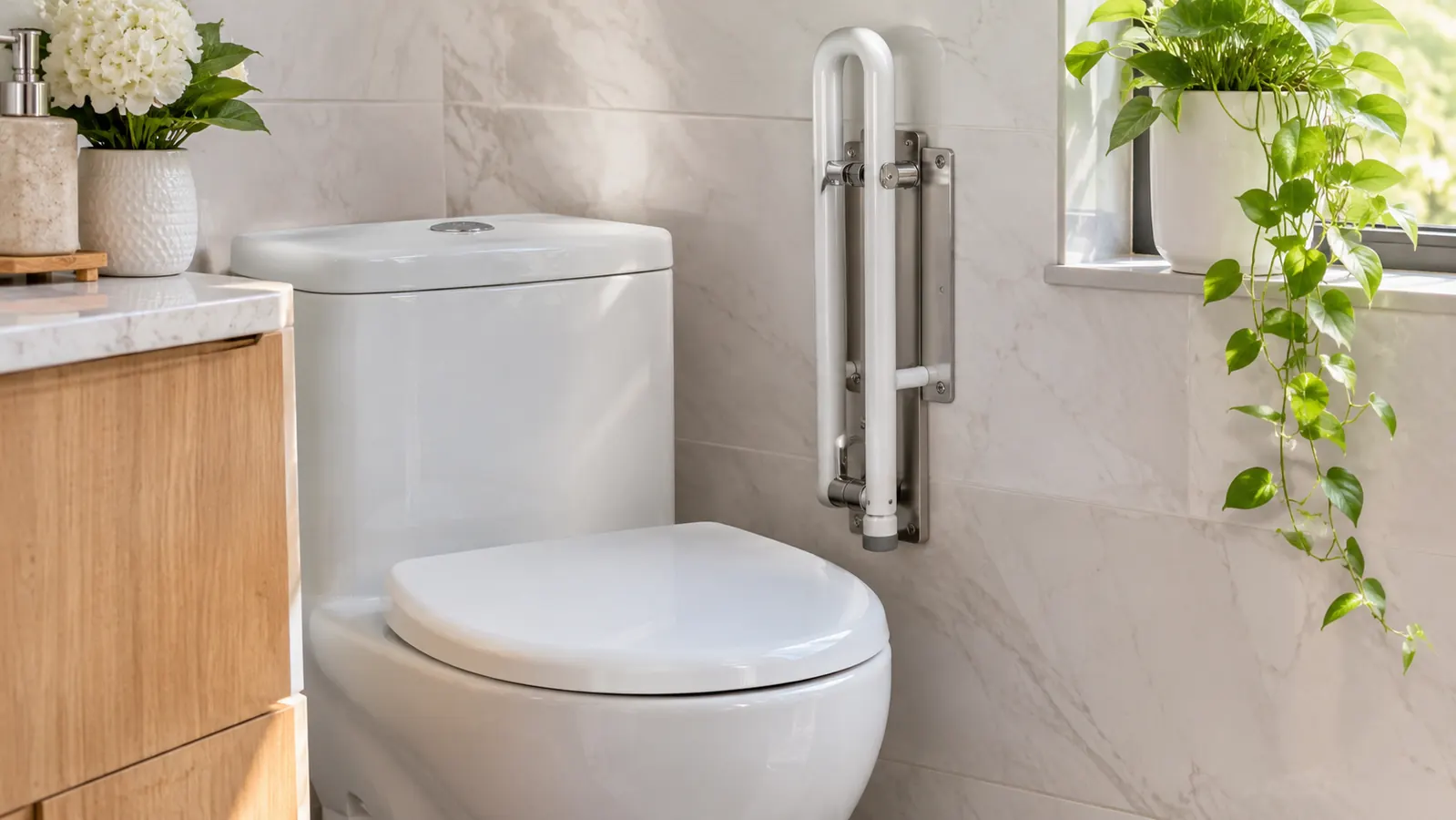
The second big win is adjustability. The rail adjusts from 27.5 to 31.5 inches, so I set it where my physical therapist suggested and it has stayed there for almost two years. The width between the arms adjusts from 18 to 24 inches, which meant I could fit it around the toilet without it feeling cramped. It also folds flat, so when Kathleen comes over and we have people in the house, I fold it against the toilet and it is out of the way. At 4.4 pounds, I can move it myself, which matters when you live alone.
I set the rail to about 29 inches, the middle of its range, where my physical therapist told me to start. The first week I still braced a hand on the wall out of habit. By the second week I stopped. Now I do not think about it at all. That is the whole review in one sentence: the rail turned a scary moment into a non-event.
Where the Raised Toilet Seat Wins
I am not going to pretend the raised seat has no place. It does. If your toilet is genuinely low and your legs are the problem rather than your balance, a few extra inches of height means you do not have to bend as far. That is a real benefit, and for some people it is enough. It is also usually the lower-cost option, which matters if you are paying for several pieces of gear at once, the way I did after surgery.
The raised seat is also easier to remove when you have guests. You lift it off, set it aside, and your bathroom looks like nothing changed. With the rail, it is always there, which I actually prefer, because I would rather have it and not need it than need it and not have it. But I understand why someone would want the option to hide it. If your main concern is keeping the bathroom looking unchanged for visitors, the raised seat wins that argument.
The rail I still use every day
The Medline Toilet Safety Rail gives you a padded armrest on each side, adjusts to your height, and folds flat when you do not need it. It has been in my bathroom for almost two years, and it is the one I would buy again.
Amazon Check Today's Price on Amazon →Who Should Buy Which
Buy the Medline rail if you have trouble standing up from the toilet, if your balance is unsteady when you are tired, if you have had knee or hip surgery, or if you simply want something sturdy to hold onto in the middle of the night. That last one is not a small thing. I keep the rail up all the time because the 2 AM trip to the bathroom is when I am least steady.
Buy the raised toilet seat if your toilet is unusually low, if your arms are strong and your balance is good, or if you want something you can remove when guests come over. And honestly, some people use both. The raised seat shortens the distance down, and the rail gives you something to push against. If your doctor or physical therapist thinks you need both, both is a reasonable answer.
Here is the way I think about it now. The raised seat answers the question of how far down you go. The rail answers the question of how you get back up. For me, getting back up was the harder question, so the rail won. For someone else, the answers might be different, and that is fine. There is no prize for picking the one I picked. There is only a prize for picking the one that keeps you steady.
The raised seat made the toilet taller. The Medline rail made me steady. Those are two different jobs, and I needed the second one.
The 2 AM Test
Here is the test that settled it for me. In the middle of the night, half asleep, I had to use the bathroom. With the raised seat, I sat down fine, but when I tried to stand up, I had nothing to hold. I put my hand on the wall, then the towel bar, and I still wobbled. It scared me enough that I called Kathleen the next morning and told her I was switching.
With the Medline rail, the same trip is boring. I reach for the padded armrest, push, and I am up. No wall, no towel bar, no wobble. That boring middle of the night trip is exactly what I want from a piece of bathroom gear. Excitement is for pickleball, not for the bathroom at 2 AM.
One night, about three weeks after the switch, I got up in the dark and walked to the bathroom without turning on the light. I sat down, did what I needed to do, and stood up using the rail. Only when I was back in bed did I realize I had done the whole thing without thinking. No bracing, no wobble, no pounding heart. That was the night I started trusting it.
What About Using Both?
When I told my physical therapist I was comparing the two, she said something I did not expect: for some people, the answer is both. The raised seat shortens the distance you lower yourself, which helps if your knees are stiff. The rail gives you something to push against, which helps if your legs are tired. They solve different parts of the same problem.
I ended up with just the rail, because the raised seat changed the height of the toilet in a way that felt wrong for me. But I can see exactly why someone else would use both, especially in the first weeks after surgery. If you are not sure, ask your physical therapist. They can watch you sit and stand and tell you which one you actually need, or whether you need both.
What I Would Tell a Friend
If we were sitting at my kitchen table and you told me you were trying to decide, here is what I would say. Rent or borrow the raised seat first if you can, because it is the cheaper experiment. Use it for a few days and watch yourself honestly. If you find yourself bracing a hand against the wall or the towel bar to stand up, that is your answer. You need the rail.
I know the rail looks more medical. I had the same thought. But I got over it the first time I stood up without grabbing the wall. Two years later, I do not think about it. I just use it. That is what I want for you: a bathroom where you do not have to think, where you can get up and get on with your day, whether that day is Mahjong at the senior center, poker night with the neighbors, or just a quiet morning with the paper.
I will also tell you what I wish someone had told me. Do not wait until after surgery to figure this out. I bought the raised seat before my knee replacement, when I could still test things calmly. If I had it to do over, I would have set up the rail before surgery too, so I came home to a bathroom that was already ready. The last thing you want that first week is to be assembling anything.
One more thing. Check the weight rating on the listing before you buy, because the right fit depends on your size and your toilet. And ask your physical therapist to show you the right height. Mine set the rail for me in about a minute, and that minute saved me months of fiddling.
The Bottom Line
If I had to choose one piece of bathroom gear for an active senior, it would be the Medline Toilet Safety Rail. It does not look like much, but it does the one job that matters: it gives you something solid and padded to push against every time you sit down and stand up. That is the job I needed done, and it is the job it has done for me for almost two years.
The raised toilet seat is not a bad product. It is a good product for a different problem. Figure out which problem you actually have, and the choice gets easy. If it is height, buy the seat. If it is steadiness, buy the rail. And if you are still not sure, ask your physical therapist to watch you stand up from the toilet. That two minute conversation will tell you more than any review.
Start with the Medline Toilet Safety Rail
It is the one I kept, the one I use every day, and the one I would buy again without hesitating. Check today's price on Amazon and see if it fits your bathroom the way it fits mine.
Amazon Check Today's Price on Amazon →