

Nobody tells you that the hardest part of a rollator is not walking with it. It is lifting it. I learned that in a medical supply parking lot about twenty months ago, a few months after my left knee replacement, when my physical therapist cleared me to move on from the standard walker. My daughter Kathleen and I stood there looking at the Drive Medical rollator, and I thought, that is a sensible piece of equipment. I did not think about how much it weighed. I have thought about it almost every time since.
Let me back up. I am Bernie, I am 72, and I live alone in a single-story house in Watsonville, California, with two steps up to the front porch. I had my left knee replaced about two years ago, and the surgery went fine. What nobody warns you about is the season after, when your balance is a little off and you get tired faster and the ground suddenly seems farther away than it used to. My physical therapist had me on a standard walker first, then said I was ready for something with wheels. So I bought the Drive Medical rollator, and I have used it nearly every day since for groceries, the walk to the park, and Mahjong Tuesdays at the senior center. This is the honest review, the one I would give a friend over the card table. The good parts and the annoying parts.
The Quick Verdict
Twenty months in, this is the most stable and useful mobility aid I own, and also the one I complain about lifting. I would buy it again tomorrow, and I would ask Kathleen to carry it.
Amazon Check Today's Price →The rollator I reach for every single day
After twenty months of grocery runs, park walks, and Mahjong Tuesdays, the Drive Medical rollator is still my everyday outing aid. Check today's price on Amazon before you decide.
Amazon Check Today's Price on Amazon →How I've Used It
For the first month, I used the Drive Medical rollator the way I used the standard walker: hands on the grips, stop, breathe, go. It took me a while to trust the wheels. The standard walker does not roll unless you pick it up, and I had gotten used to that little pause. The rollator rolls all the time, which is the point, but I spent a few days treating it like a cart that might run away. My physical therapist told me to keep my hands light and let the rollator do the steadying. Eventually that clicked, and now my hands rest on the grips instead of strangling them.
These days it is my outing aid, full stop. It goes to the grocery store, where I lean on it through the produce aisle. It goes to the park on Saturday mornings, where I play a gentle game of pickleball doubles or just watch. And it goes to the senior center every Tuesday for Mahjong, where the seat gets as much use as the wheels, because I sit on it while I wait for the table to open. I also use it at home on the days my balance feels off, especially when I am tired. My physical therapist says that is exactly what it is for.
The routine is always the same. I fold it, lift it into the trunk of my small sedan, drive the few miles to wherever I am going, unfold it, and walk in. Folding is easy. Unfolding is easy. The part that is not easy is the lifting, and I will get to that in a minute.
What I Love About the Drive Medical Rollator
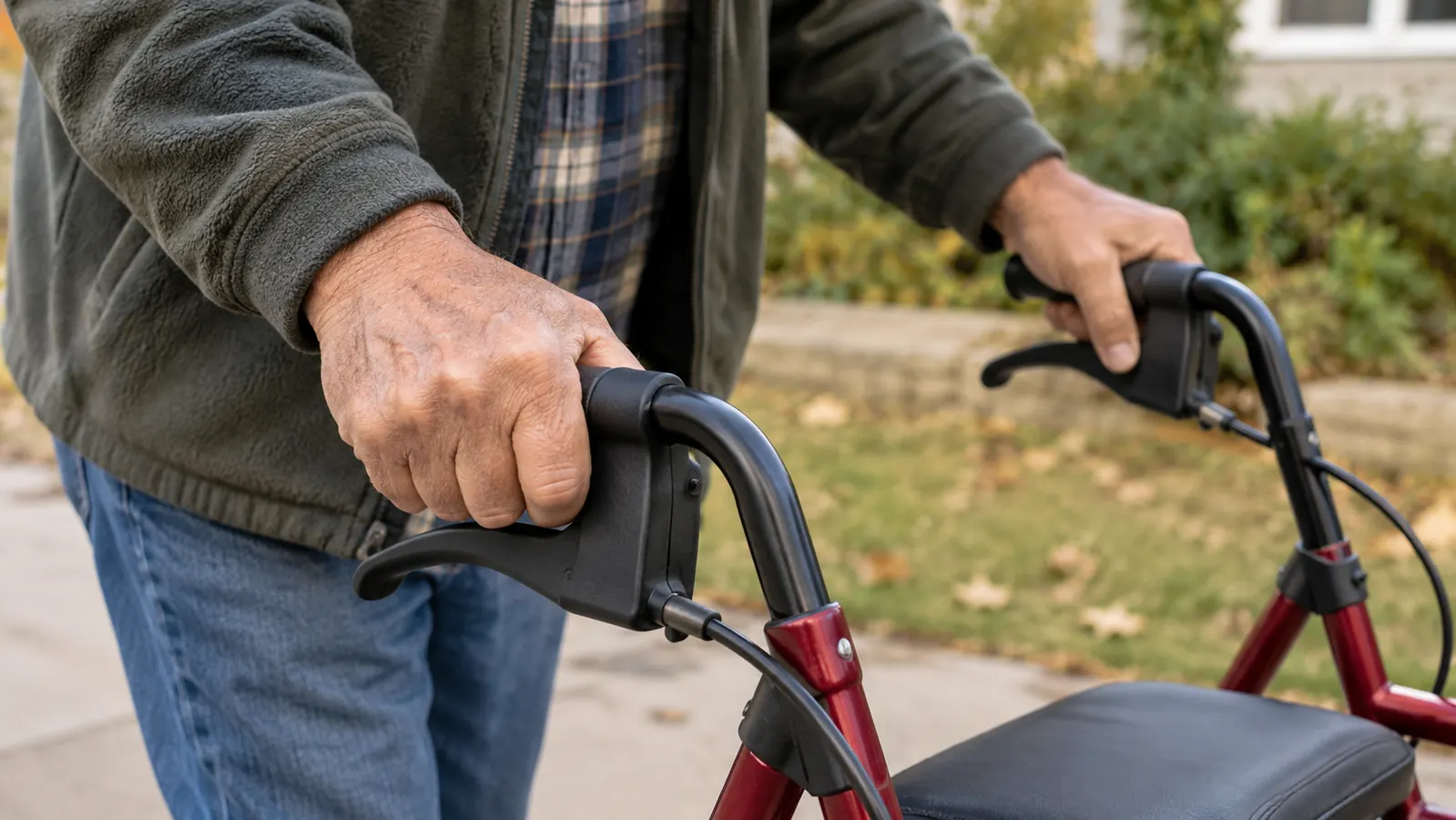
Start with the obvious. The steel frame is solid, and the four wheels make it feel steady under my hands. I never worry about it tipping, even when I stop short at a curb or when somebody at the senior center bumps into it while I am standing. The weight capacity is 350 pounds, which is not a number I need to think about, but it tells you the frame is built for adults. The limited lifetime warranty does not hurt either.
The wheels are 7.5 inches, and they handle the walk to the park better than I expected. Sidewalk cracks, the smooth concrete of the grocery store, the little patch of gravel by the gate, all of it is fine. I do not have to lift the front wheels over much. When I do, the frame is light enough up front that it cooperates.
The height adjustment lever matters more than I thought it would. My physical therapist set the handles where she wanted them, and the lever means I can change the height when I wear different shoes or when my posture is off at the end of a long day. It is a small thing. It is also the difference between a rollator that feels like part of you and one that makes you hunch.
And the seat. The seat is the reason this rollator comes to Mahjong with me instead of staying in the garage. When the table is full and I am waiting, I sit. When I am tired at the far end of the grocery store, I sit. The back support folds up and removes when I want the rollator at its most compact, but I mostly keep it in place, because it turns the seat into a chair instead of a ledge.
What Annoys Me, and Nobody Warns You
Now the honest part. The Drive Medical rollator weighs about 20 pounds. That is not heavy when you are pushing it. It is heavy when you are lifting it into a trunk. My sedan has an ordinary trunk, and the rollator folds down to about 31.5 by 24.5 by 10.75 inches, which fits fine. But fitting is not the same as lifting. I have to angle the frame, get a grip, and hoist it up and over the lip of the trunk. Some days that is fine. Some days my hands, which have their own arthritis, do not want to cooperate, and I stand in the parking lot feeling annoyed at a very good piece of equipment.
Kathleen helps when she can, and a neighbor helps when Kathleen cannot. That is the part nobody tells you: a rollator this good can still be a two-person job at the car. If you have a hatchback or a truck bed at hip height, this is a non-issue. If you have a sedan like mine, plan for the lift.
The second annoyance is the wheels on loose ground. On pavement and store floors, the 7.5 inch wheels are great. On a soft dirt path or a thick lawn, they dig in, and the rollator wants to stop while you keep going. I learned to take the paved route to the park, which is fine. I just wish somebody had told me this is a pavement walker first and an off-road walker second.
The third thing is smaller. The brakes are hand brakes, and they work exactly the way my physical therapist taught me to use them. I squeeze them at every stop, and the rollator holds still. But the squeeze takes a firm hand, and on a long walk my arthritic hands get tired. It is not a reason to skip this rollator. It is a reason to try the brakes before you buy and to ask your physical therapist about the right way to use them.
What I Liked
- Solid steel frame with a 350-pound weight capacity that never feels tippy
- 7.5 inch wheels roll smoothly on pavement and store floors
- Seat with fold-up removable back support, genuinely useful for waiting and resting
- Height adjustment lever makes it easy to set the handles where your physical therapist wants them
- Folds compact enough for an ordinary sedan trunk
- Limited lifetime warranty
Where It Falls Short
- About 20 pounds, and the lift into a sedan trunk can be a two-person job
- Wheels dig into soft dirt and thick grass; this is a pavement rollator
- Hand brakes need a firm squeeze that tired or arthritic hands may find tiring
- The removable back support adds a step when you fold it to its most compact size
That is the part nobody tells you: a rollator this good can still be a two-person job at the car.
The First Month: What to Expect
If you are new to a rollator, give yourself a month. The first week, everything feels strange. The rollator rolls when you expect it to hold still, and it holds still when you expect it to roll. You will grip the handles too hard, and your shoulders will ache by the end of the day. That is normal. My physical therapist told me the walker phase is about learning to trust your legs again, and the rollator phase is about learning to trust the wheels.
By the second week, the rhythm comes. You learn to glide up to a chair, squeeze the brakes, and sit down on the seat without thinking about it. You learn to angle the rollator through a doorway. You learn which sidewalks in your neighborhood are smooth and which ones have a lip you need to watch. By the end of the month, the rollator stops being a thing you are carrying and starts being a thing that carries you.
One more thing about the first month: you will notice how much attention a rollator gets. Strangers hold doors. Cashiers ask if you need help. Kids stare, and then their parents tell them to be careful around you. I am not going to pretend that is not a little uncomfortable at first. Then you realize everyone is just trying to be kind, and the rollator is the reason you are out at all, so you take the kindness and keep walking.

How It Holds Up After 20 Months
Twenty months of grocery stores, park walks, Mahjong Tuesdays, and the occasional Saturday pickleball game, and the Drive Medical rollator still looks and works the way it did the week I bought it. The frame has no wobble. The wheels roll true. The seat is as firm as it was on day one. I have not had to tighten a single thing, and nothing has worn out. The limited lifetime warranty is nice to have in the back of my mind, but I have not needed it.
The honest caveat is that I take care of it. I fold it before it goes in the trunk. I do not leave it out in the rain. I wipe the frame down when it gets dusty. A rollator is simple machinery. Treat it like a good pair of shoes, and it will treat you the same way.
The other thing that has held up is my confidence, and that is the part I did not expect. In the first weeks, I gripped the handles like I was holding on for dear life. Now my hands are light on them, and the rollator is just there, doing its job. My physical therapist says confidence is built in small steps, and she is right. This rollator has been the steadiest of those steps.
I will also say this. My house has two steps up to the front porch, and for a while those two steps were the scariest part of my day. The Drive Medical rollator does not climb steps, and no rollator should. I use it to get to the porch, then I take the standard walker or the cane for the steps themselves, depending on the day. Knowing the limits of each aid is part of using them well, and my physical therapist drilled that into me.
What I'd Tell a Friend at the Card Table
If we were sitting at my kitchen table, here is what I would say. Do not buy a rollator because it looks impressive in the catalog. Buy it because you can lift it, because the wheels match the ground you actually walk on, and because the seat is comfortable enough to sit on for ten minutes. The Drive Medical rollator checks those boxes for me. It might not check them for you, and that is a perfectly good reason to keep looking.
And if you are buying it for someone else, buy it with them. Let them try the brakes, set the height, and lift it once before you commit. The person who will live with a rollator should be the person who chooses it. That is the advice I wish somebody had given Kathleen and me in that parking lot twenty months ago.
Who This Is For
The Drive Medical rollator is for someone who is past the standard walker stage and wants to get out of the house. It is for the person who wants to walk into the grocery store instead of using the motorized cart. It is for the person who wants to sit down at the senior center without hunting for a chair. It is for the person who wants to watch pickleball from the edge of the court instead of from the car. And it is for someone who has a little upper body strength, or a daughter or neighbor who can help with the trunk.
If you are in the middle of recovery and your physical therapist says you are ready for wheels, this is the rollator I would hand you. Ask your doctor or physical therapist about fit and use first, the same way I did. Then check today's price on Amazon and decide for yourself.
Who Should Skip It
Skip it if you cannot lift about 20 pounds into a trunk, because the weight is real and it does not get lighter. Skip it if most of your walking is on dirt paths, gravel, or thick grass, because the 7.5 inch wheels are pavement wheels. And if your hands are very weak or very painful, try the hand brakes before you buy, because they need a firm, steady squeeze.
That is not a short list, and I do not apologize for it. An honest review is supposed to be honest. For me, the tradeoffs are worth it, and I would buy the Drive Medical rollator again tomorrow. I would also ask Kathleen to carry it.
The rollator I would buy again tomorrow
Twenty months in, the Drive Medical rollator is still my everyday outing aid, and the honest annoyances do not change the verdict. Check today's price on Amazon and see if it is the right fit for you.
Amazon Check Today's Price on Amazon →