

Two years ago, after my left knee replacement, my physical therapist told me I was ready to move on from the standard walker. I bought a Drive Medical rollator with a seat and 7.5 inch wheels, and it got me to Mahjong on Tuesdays and gentle pickleball on Saturdays. But the first time I tried to put it in my small sedan trunk, I stood there for ten minutes, pushed, pulled, turned it sideways, and finally called my daughter Kathleen to come help. This is the method we worked out together. It has made the difference between using the rollator and leaving it home.
The problem is not the rollator. It is the trunk. A small sedan trunk is shorter and shallower than people expect, and a rollator is awkward because it folds long before it folds small. The frame collapses, but the wheels still stick out. If you lower it in flat, it catches on the lip. If you angle it, it wedges against the hinge. The trick is to fold it completely, turn it on its side, and slide it in wheels first, seat down. It sounds simple, but nobody showed me, and I wasted a lot of energy learning it.
The rollator that fits, once you know the fold
The Drive Medical rollator folds with a lever on the frame, and at 20 pounds it is manageable for most people with one good knee. Check today's price on Amazon to see the current listing.
Amazon Check Today's Price on Amazon →The Rollator I Load Into the Trunk
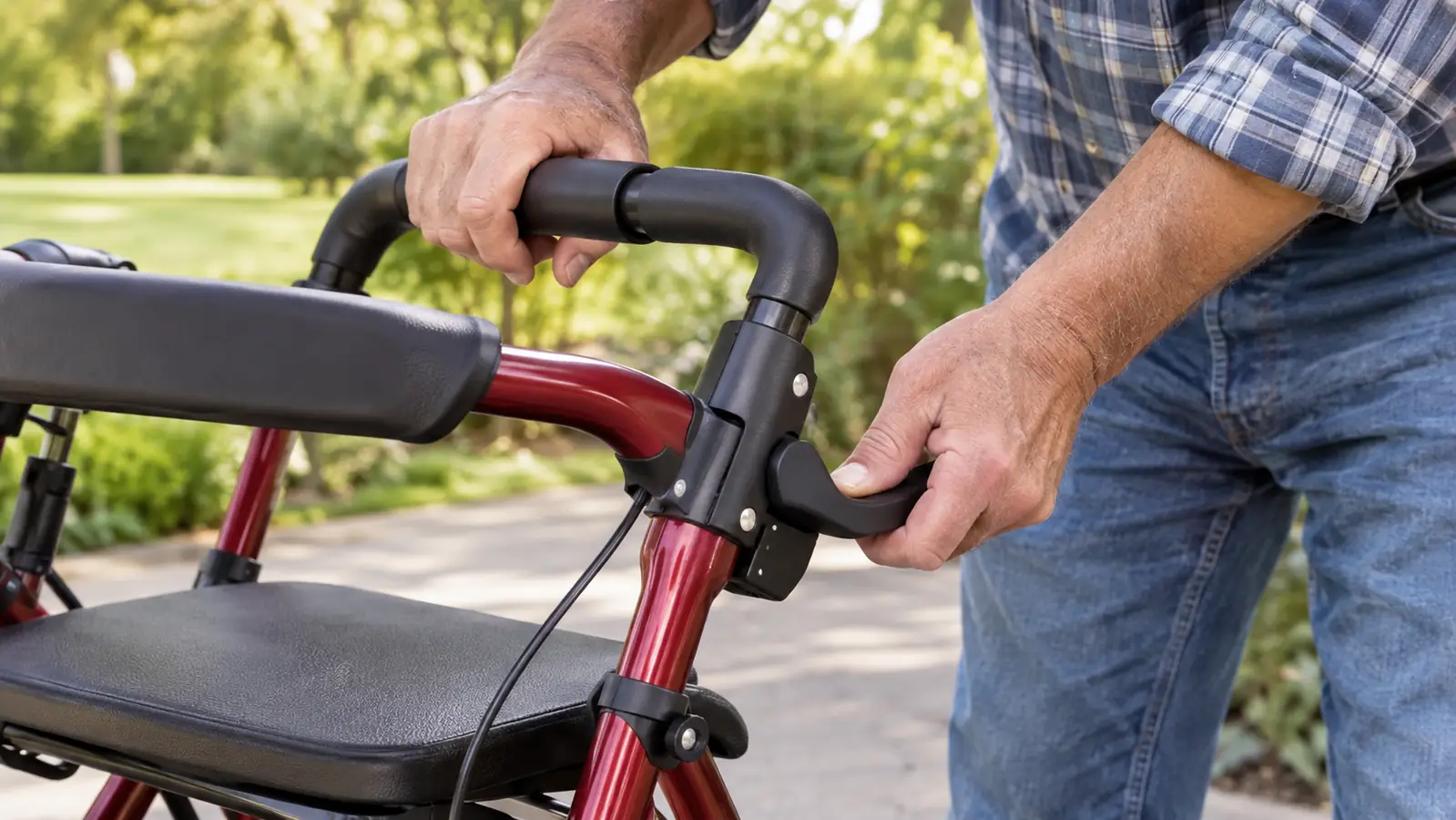
The rollator I use is the Drive Medical model with a seat, 7.5 inch wheels, and a steel frame. It weighs about 20 pounds, which is on the heavier side, but the weight is what makes it feel steady when I walk to the park or wait for my turn at pickleball. The listing says it is rated for up to 350 pounds, and the height adjusts with a lever on the frame.
The seat is what sold me. At the senior center, I sit on it while I wait for the Mahjong table to open. The back support folds up and is removable, so I can take it off if I need a little more room in the trunk. The 7.5 inch wheels roll smoothly over the sidewalk cracks outside my house.
Step 1: Park on level ground and clear the trunk
Before you lift anything, park on level ground. I learned this after trying to fold the rollator on a slope and watching it roll away from me while I held the seat. Keep one hand on the frame at all times. If the ground is uneven, the rollator will not stay where you put it.
Open the trunk all the way. Take out anything loose, like the bag of reusable grocery bags or the umbrella I keep in the corner. You want a flat, empty surface so the rollator does not catch on anything while you slide it in.
Position yourself beside the trunk, not in front of it. That way you can guide the folded rollator with both hands and you do not have to reach across your body. With a healing knee, reaching and twisting is exactly what you want to avoid.
Step 2: Fold the rollator completely, seat first
Every rollator folds a little differently, so check your own model. On the Drive Medical rollator, the seat lifts up and the sides come together. I do it in two motions: I lift the seat, then I press the release lever on the side of the frame and pull the handles toward each other. The frame collapses into a narrow shape, which is what makes it possible to fit in a trunk at all.
The listing gives the product dimensions as 31.5 by 24.5 by 10.75 inches, and the weight as about 20 pounds. That is not tiny, but it is small enough to slide into a sedan trunk once it is on its side. If the rollator has a removable back support, fold it down or take it off before you try to load it.
Make sure the back support is folded or removed. On this rollator, the back support folds up and is removable. If you leave it up, it adds height and catches on the trunk lid. I keep mine folded down unless I am sitting on the seat at the senior center.
Step 3: Turn it on its side, wheels pointing toward the back of the car
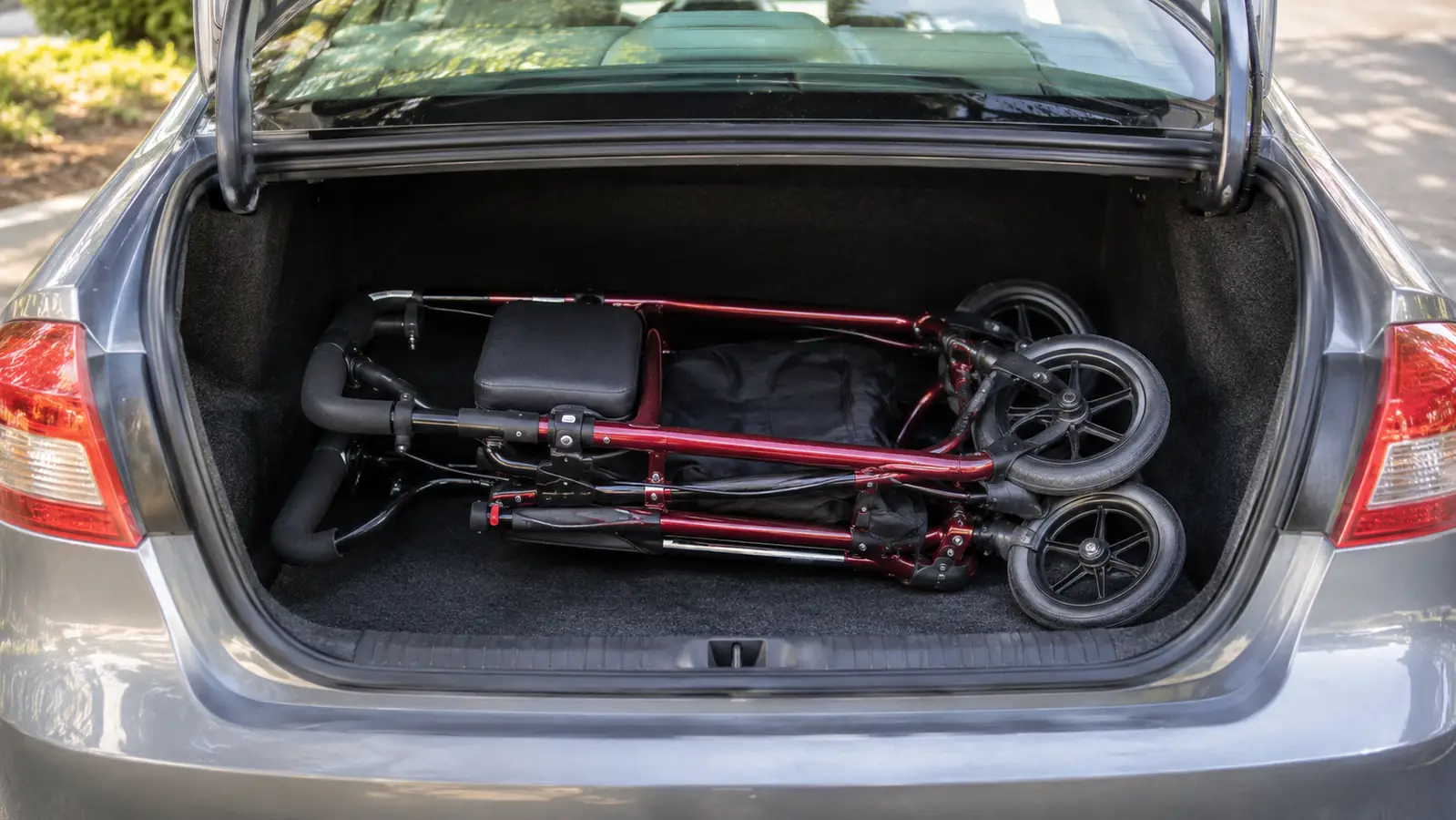
Here is the part I got wrong for weeks. Do not try to lower the rollator into the trunk flat, with all four wheels down. It is too wide and it hits the trunk opening. Instead, turn the folded rollator on its side so the wheels face the same direction, toward the back of the car. The seat side goes down, and the handles point up toward you.
Slide it in wheels first. Because the wheels are 7.5 inches, they are the bulkiest part, so they need to go in first and sit against the back of the trunk. The handles stay near the trunk opening, which means you can reach them to pull the rollator out later without climbing into the trunk.
If you have a second person, this is the moment to ask for help. Kathleen holds the handles while I guide the wheels. One person can do it, but two people make it feel easy, especially on a bad knee day.
Step 4: Angle it over the trunk lip and let the wheels drop in
The trunk lip is the obstacle. If you push the rollator straight in, the wheels catch on the edge. Instead, tilt the folded rollator so the front wheels are a little higher than the back wheels, then lower the back wheels over the lip. Once the back wheels clear the lip, the rest of the frame follows.
Let the wheels drop into the trunk one pair at a time. I put the rear wheels in first, then guide the front wheels in behind them. The rollator settles diagonally, with the seat against the side of the trunk. It looks like it should not fit, but it does. The diagonal position is the whole trick.
Step 5: Close the trunk slowly and check the lid
Before you close the trunk, check that the handles are not sticking up above the lid. On my Drive Medical, the handles are the tallest part when the rollator is on its side, so I push them down until they are below the trunk opening. If the lid will not close, do not force it. Pull the rollator out and try the other direction, or angle it more.
Once the lid closes, give it a gentle push to make sure nothing is wedged. I also keep a folded reacher grabber in the car, so I can pull the rollator out without bending too far. It is a small thing, but it saves my knee every time.
What If It Still Does Not Fit?
Some trunks are simply smaller than others. If the rollator still will not fit after you have folded it, turned it on its side, and angled it over the lip, do not fight it. Take the back support off and lay it flat on top of the folded frame. That usually buys you the extra inch you need.
You can also try putting the rollator in the back seat instead of the trunk. With the car's back seat folded down, the rollator lies flat across the seat, and the handles tuck into the footwell. It is not as tidy, but it works, and it is easier on your back because you do not have to lift as high.
Another option is to leave the rollator at home and take the cane for that particular trip. I do this sometimes for short errands. The Drive Medical rollator is my outing aid, but the cane is lighter for quick trips. Ask your physical therapist what makes sense for you.
Why the Diagonal Works
Once you understand why the diagonal works, it is easier to remember. A trunk opening is roughly rectangular. A folded rollator is also roughly rectangular, but its longest side is the distance from the handles to the wheels. When you lower it in flat, that longest side has to fit across the opening, and it does not. When you turn it on its side and slide it in diagonally, the longest side runs from the back corner of the trunk to the front corner, which is the longest distance in the trunk.
That is why the wheels go in first. The wheels are the widest part, and the back corner of the trunk is the deepest part. The seat goes down because it is flat and slides easily over the trunk liner. The handles stay up because they are thin and fit under the lid. Every piece has a job.
This is the kind of thing that looks obvious once someone shows you, but nobody showed me. I hope this saves you the ten minutes I spent in the parking lot, and the phone call to your daughter.
A Note About Your Back and Knee
Lifting a 20-pound rollator is not a test of strength. It is a test of technique. The worst thing you can do is bend at the waist and heave. Instead, stand close to the trunk, bend your knees, and let your legs do the lifting. Keep the rollator close to your body. If you feel a pull in your lower back, stop and ask for help.
After my knee replacement, I learned to listen to my body. Some days the rollator feels light, and some days it feels like it weighs twice as much. On the heavy days, I do not argue with it. I wait for Kathleen, or I ask a stranger in the parking lot. People are kinder than you expect, and most are happy to help an older woman load a walker.
What Else Helps
A few things made the whole routine easier. I keep a pair of work gloves in the trunk, because the steel frame can be cold and the wheels are dirty. I always fold the rollator before I load groceries, not after, because a full trunk leaves no room to maneuver. If your trunk is very small, take the removable back support off and stow it beside the rollator; it takes up almost no space. And if the rollator is too heavy for you to lift, do not feel bad about asking for help. I ask Kathleen or a neighbor at the grocery store. There is no prize for loading it yourself.
One more thing: practice at home before you need to do it in a parking lot. Fold and unfold the rollator in your living room a few times until the motion feels automatic. The first time I folded it in a grocery store parking lot, I fumbled for a full minute. Now I can do it in about twenty seconds, and that confidence is worth as much as the fold itself.
The diagonal is the whole trick: wheels first, seat down, handles low, and a small sedan trunk suddenly has room.
Ready to make the trunk part easy?
The Drive Medical rollator folds small enough for a sedan trunk once you know the diagonal method. Check today's price on Amazon and see the current listing.
Amazon Check Today's Price on Amazon →