

I will tell you straight: I bought the Lunderg bed assist rail because I had a wobbly moment getting out of bed in the dark, and it scared me more than I want to admit. I am Bernie, 72, two years past a knee replacement, and I have learned the hard way which mobility aids actually earn their spot next to the bed and which ones end up in the garage. After eight months of using this rail every single morning and most nights, here is the honest review I wish I had found before I ordered it: what I love, what annoys me, and what nobody tells you about living with a bed assist rail.
The short version: the Lunderg does its one job very well. It gives me a sturdy thing to grab when I sit up and stand, it went in with no tools in about five minutes, and it has not moved a millimeter since Kathleen, my daughter, set it up. But it is not perfect, it is not invisible, and there are a few things about mattress fit and bed skirts that I would have liked to know before I opened the box.
The Quick Verdict
A sturdy, simple rail that does exactly one job well: getting me out of bed without grabbing the nightstand. The honest catch is mattress fit and the way it sits under the sheet.
Amazon Check Today's Price →Get a Steady Hand for Those 3 A.M. Trips to the Bathroom
The Lunderg bed assist rail is the thing I grab before my feet even touch the floor. If you or someone you love has had a shaky moment getting out of bed, this is the rail I would buy again tomorrow.
Amazon Check Today's Price on Amazon →Why I Finally Ordered a Bed Rail (and Why It Took Me So Long)
For the first year after my knee replacement, I managed fine getting out of bed. I would roll to the edge, push up with one arm on the mattress, and take that first careful step. Then one night about eight months ago I woke up disoriented, reached for the nightstand, and found nothing but air. I caught myself on the mattress edge, but my heart was pounding and I stood there in the dark talking myself down. The next morning I called Kathleen and said I was done being proud about this.
Let me fill in that night, because the details are exactly why I ordered what I ordered. It was a Tuesday, which meant Mahjong at the senior center that afternoon and a later dinner than usual. I had slept poorly, got up around 2 a.m. for the bathroom, and came back to bed on the far side, closer to the footboard than my usual path. The nightstand was a full arm's length away, and the cane I sometimes keep propped against the bed had fallen over sometime during the evening. So there I was, half awake, one hand on the mattress and nothing else within reach. I did not fall, but I came closer to it than I like to remember, and the next day my shoulder ached from the way I caught myself.
I spent the next week looking at options with Kathleen. We measured the bed, read a lot of listings, and I ruled out anything that bolted to the frame because my bed is a simple metal frame and I did not want a project. A bed ladder looked less like medical equipment, and I nearly ordered one. But my physical therapist settled it in one sentence: a ladder is for pulling yourself up, and a rail is for pushing against while you stand. I get out of bed by rolling, sitting up, and pushing, so the rail matched how I actually move. That conversation is why I tell everyone to ask their own therapist before they buy anything, because the right aid is the one that matches your own habits.
Setting It Up: The Five Minutes That Actually Happened
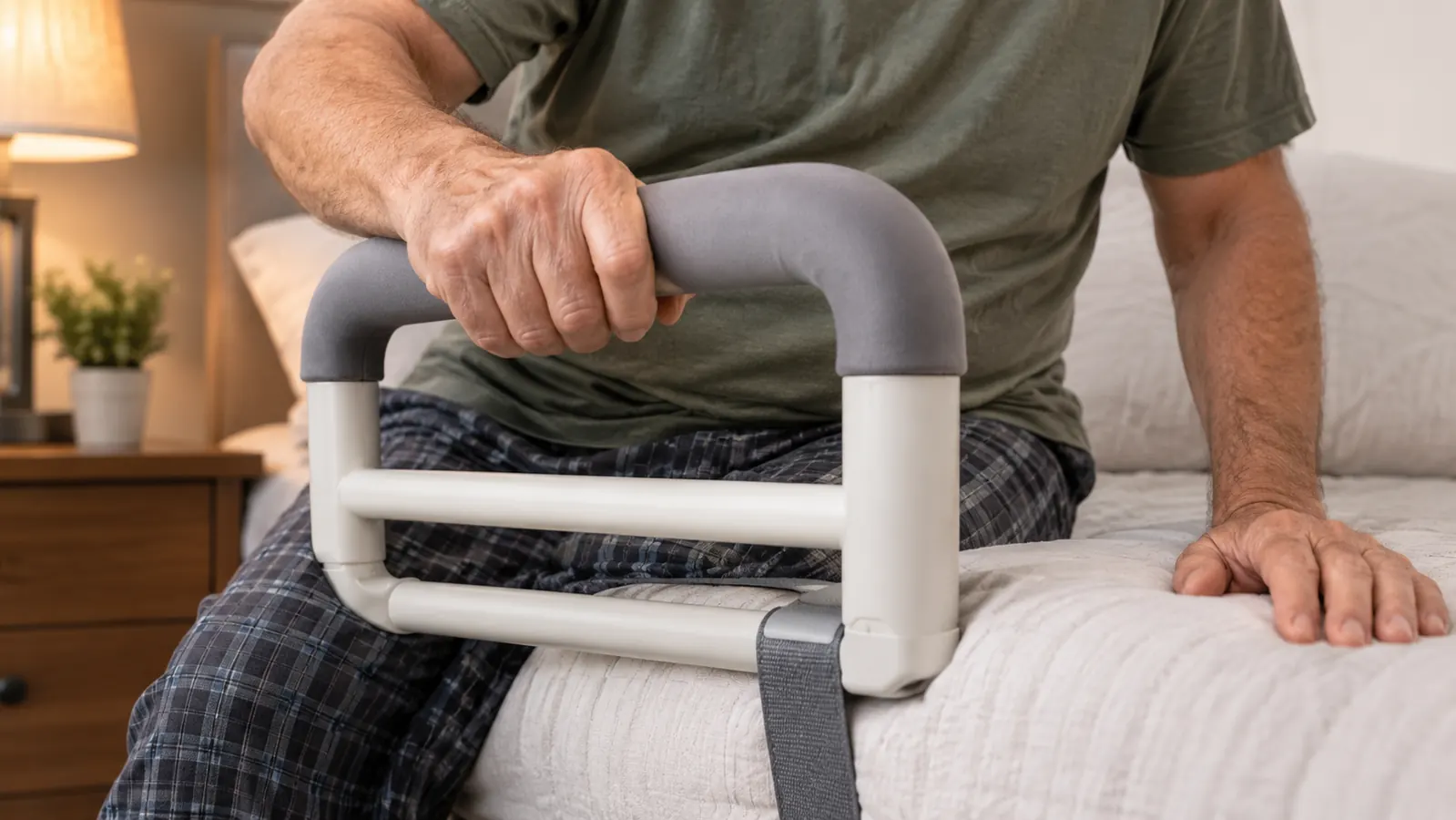
The listing says tool-free setup in about five minutes, and for once the listing is telling the truth. The rail arrived partly pre-assembled. Kathleen and I slid the U-shaped steel frame under the mattress, positioned it where I would naturally reach, and tightened the adjustable strap that secures it. No screwdriver, no reading glasses, no small parts scattered on the floor. From opening the box to testing it with my full weight, I would say five minutes, maybe six.
The one thing I will say about setup: the strap needs to be snug, and it takes a little muscle to get it there. Kathleen did the final pull for me because my hands have mild arthritis and the strap was stiff when it was new. That is not a complaint about the product, it is just the honest truth of who does what in my house. If you have strong hands, you will not even think about it.
What I Love: The Steady Mornings
The real test of a bed rail is not the first day, it is the two hundredth. Eight months in, here is what I love. The Lunderg is genuinely sturdy. It is made of heavy-duty carbon steel, and the listing says it is load-tested to 300 lb. I am not anywhere near that number, but I have put my full weight on it every morning and it has never flexed, wobbled, or shifted. The non-slip grab bar is comfortable to hold, even when my hands are stiff first thing in the morning.
It has also changed the way I start my day. Before the rail, I would sit up, brace myself, and mentally rehearse the stand before I committed to it. Now I reach for the bar, pull myself upright, and take that first step with my hand still on it. That first steady step used to be the hardest part of my whole day. Now it is the easiest. My confidence improved over the first few weeks, not overnight, and it has stayed steady since.
A typical morning looks like this. The alarm goes off at 6:15, I sit up slowly, and my left hand finds the grab bar before my feet look for the floor. I hold the bar while I stand, take one breath, and then walk to the bathroom with my hand trailing along the wall. It sounds like a small thing, but it is the difference between starting the day steady and starting it braced. On Saturday mornings I am out the door for gentle pickleball doubles at the park, and the steadiness I practice first thing in the morning carries through the whole day. Kathleen laughed when I told her the rail was my favorite piece of furniture, but she stopped laughing when she used it herself to help me change the sheets.
One more thing I love: the rail does not judge me. Some of the other aids in my house are reminders that I am not as steady as I used to be, but this one just sits there, quiet and useful. It is the first thing I touch in the morning and the last thing I touch at night, and after eight months I do not think about it anymore. That, to me, is the highest compliment a piece of mobility gear can get. The best aid is the one you stop noticing because it simply works.
Eight months in, I have put my full weight on it every single morning and it has never flexed, wobbled, or shifted. That is the whole job, and it does it.
What Nobody Tells You: The Mattress Fit Question
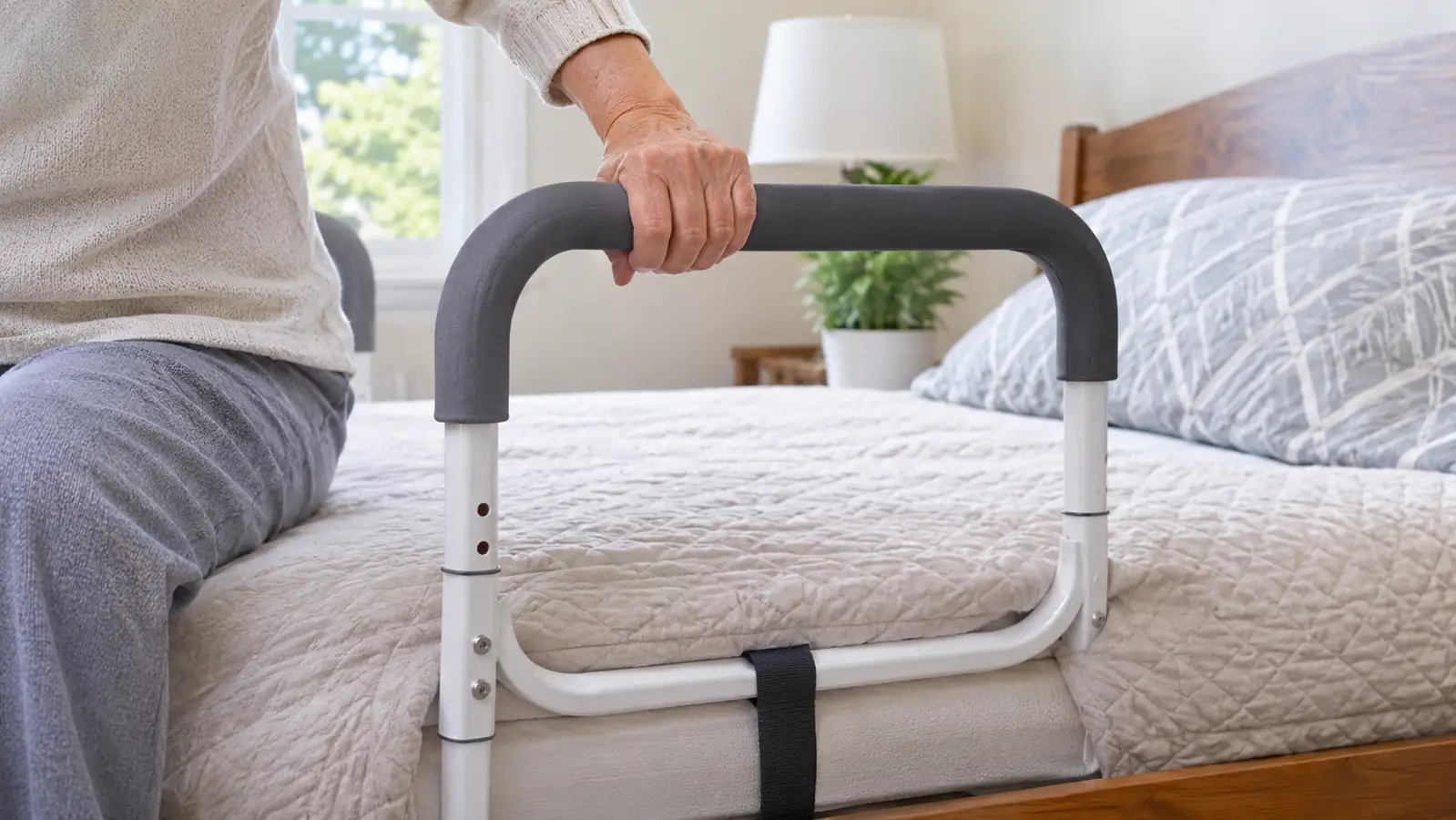
Here is the honest part, and the reason I wrote this review. The Lunderg is designed for mattresses 7 to 13 inches thick, and it fits a twin through king. My mattress is right in that range, so the fit is good. But I have learned from helping friends shop for these that the thickness of your mattress matters more than you think. If your mattress is on the thin side, the rail sits lower and you have to bend more to reach it. If it is on the thick side, the rail sits higher and the strap has less to grab onto. Measure your mattress before you order, and do not guess.
The second thing nobody tells you: the rail tucks under the mattress, which means it lives under your fitted sheet. That is fine for the rail itself, but it changes how you make the bed. The sheet has to go over the rail, and the part of the rail that sticks up above the mattress is about 13 inches of steel poking out from under your pillow. I have bumped my elbow on it more than once when I was not thinking. It is a small thing, but it is a real thing, and I would rather tell you about it than have you discover it at 2 a.m.
Let me give you the measurements, because this is the part I had to learn by trial and error. My mattress measures about 10 inches thick, squarely in the middle of the 7 to 13 inch range, and the rail sits at a height that is comfortable for me to reach from a seated position. But a friend of mine, who borrowed the rail for a weekend to try it before ordering her own, has a plush mattress that measures closer to 14 inches with the topper, and the strap had almost nothing to grab. She ended up removing the topper, which fixed the fit, but it is exactly the kind of thing you want to know before you buy, not after.
There is also the bed skirt question, which nobody mentions anywhere. If you use a bed skirt, the rail pushes it out of place on that side of the bed, and the skirt rides up over the strap. I gave up on the bed skirt on the rail side entirely and just tuck the fabric under the mattress. It is not a big deal, but it is one of those small adjustments that makes the difference between a product that feels like it belongs and one that feels like it is fighting your room.
What Annoys Me: The Honest Cons
What I Liked
- Rock solid: heavy-duty carbon steel, load-tested to 300 lb, and it has never wobbled in eight months of daily use
- Tool-free setup that really does take about five minutes, even for two people with limited patience
- Universal fit for twin through king mattresses, 7 to 13 inches thick, and it works on either side of the bed
- The non-slip grab bar is comfortable and grippy even when my hands are stiff in the morning
- Tucks under the mattress so I can pull the sheet over it and forget it is there
Where It Falls Short
- The steel bar sits above the mattress and I have bumped my elbow on it more than once
- The strap needs a firm pull to get snug, which was hard for my arthritic hands the first few times
- The rail changes how you make the bed, since the fitted sheet has to go over the bar
- It is a single-purpose aid: it does the bed job well, but it is not a ladder and not a full side rail
How It Holds Up Over Time
Eight months of daily use, and the Lunderg looks and feels the same as the day we installed it. The steel has no rust, the grab bar has not worn smooth, and the strap has not stretched loose. I wipe it down with a damp cloth when I change the sheets, which is exactly what the care instructions say to do, and it comes up like new. I cannot speak to ten years, but I can tell you that eight months of a 72-year-old putting her full weight on it twice a day has not fazed it.
The one wear item I watch is the strap, since it is the part doing the holding. So far it is as snug as the day Kathleen tightened it. If it ever loosens, it takes thirty seconds to re-tighten, no tools needed. That is the kind of maintenance I can actually do.
I checked it at the one-month mark, the three-month mark, and again last week, and the honest report is that nothing has changed. The grab bar still has the same texture it had out of the box, which surprised me, because I expected the non-slip surface to wear smooth where my hand grips it. The strap still holds the rail tight against the mattress, and I can slide a hand between the rail and the mattress only if I push hard, which tells me the tension is still right. The rail weighs about 1.4 kilograms, light enough that I can lift it myself when I change the sheets, and compact enough that it does not dominate the side of the bed.
It helps that the rail is a simple thing. There are no springs, no hinges, no moving parts to wear out, just a steel frame, a strap, and a grip. When something is that simple, there is less that can go wrong. I have had fancier aids fail on me, and the pattern I have noticed is that the ones that last are the ones with the fewest parts. The Lunderg is about as few parts as a bed rail can have.
Who This Is For
The Lunderg bed assist rail is for anyone who has had that moment of reaching for something solid when they get out of bed and finding nothing. It is for the person who wants a sturdy, no-fuss grab bar that does not require a contractor to install. It is for someone with a mattress in the 7 to 13 inch range who wants a rail that works on either side of the bed. And it is for the person who, like me, would rather have a steel bar to grab at 3 a.m. than a nightstand full of things that will slide and crash.
Who Should Skip It
Skip the Lunderg if your mattress is much thicker or thinner than the 7 to 13 inch range, because the fit is the whole ballgame and a poor fit means a rail that is either too low to reach or too loose to trust. Skip it if you want a full side rail that keeps you from rolling out of bed, because this is a grab bar, not a bed guard. And if you have very limited hand strength and no one to help with the first strap pull, ask someone to help you set it up or look at a bed ladder instead. This is a sturdy, honest tool, but it is not magic, and it does not fix every problem.
The Rail I Grab Before My Feet Touch the Floor
If you have had one shaky moment getting out of bed, you know exactly why I bought the Lunderg. It is the same rail I have used every morning for eight months, and I would buy it again without hesitating.
Amazon Check Today's Price on Amazon →